# Send SMS node
The **Send SMS** node allows you to communicate with your customers through text messages based on events and other conditions defined in a workflow.
When a workflow that contains this node is launched, an SMS campaign is created as a result. You can find its statistics in **Experience Hub** as well as in the **Send SMS** node itself.
The configuration of the node requires:
- selecting an account from which the message will be sent,
- selecting or creating a template
Optionally, you can:
- add custom parameters,
- send a test message
## Requirements
---
- You must integrate a SMS account in Synerise and configure SMS gateway.
You can find more information about the procedures above [here](/docs/settings/configuration/sms-account).
- You must have profiles supplemented with phone numbers of your customers.
## Node configuration
---
1. Go to **Automation Hub > Workflows > New workflow**.
2. Select one of the profile trigger nodes, for example [Profile Event](/docs/automation/triggers/client-event-node).
3. Click **THEN > Send SMS**.
4. To open the configuration form of the node, click it.
5. Optionally, next to the node name, you can add a custom node title which will be displayed on the node.
6. If you want to assign a tag to the SMS campaign you will send through the workflow, under the node title, click **Add tag**.
7. From the dropdown list, select the [tag](/docs/assets/tags).
The list contains only the tags which are available in the predefined **campaigns** tag folder.
Assigning tags helps you organize your communications by categorizing campaigns across different channels. Additionally, you can control [communication limits](/docs/settings/configuration/campaign-limits) by applying restrictions to these tags.
### Add content
---
In this part of the node configuration, you will select the SMS account from which the message will be sent and create the content of the message.
3. In the **Content** section, click **Define**.
1. From the **From phone number** drodpown list, select an SMS account from which the message will be sent.
2. If you want to:
- Select a template, click **Create message**. From the list of the templates, select the one you want to use.
- If you make changes to the template, click **Save** and then **Use in node**.
- If you don't make changes to the template, click **Use in node**.
- Create a message without using an existing template, click **Create message > New template**.
The template will be available only in this node for preview and modifications.
**Result**: You will be redirected to the SMS template builder.
1. Prepare the SMS template according to the instructions available in ["Creating SMS templates"](/docs/campaign/SMS/creating-SMS-template).
2. After finishing the template, click **Use in node**.
3. If you want to send this text message regardless of the marketing consent, tick **Send without marketing agreement** checkbox (not recommended).
2. Confirm settings in the section by clicking **Apply**.
### Adding UTM and URL parameters
---
In this part of the node configuration, you will define UTM and URL parameters that will be added to the SMS campaign launched with the start of the workflow. This part is optional.
1. In the **UTM & URL parameters** section:
- To omit this step, click **Skip step**. Otherwise, you won't be able to save the workflow with this empty section.
- To add UTM and/or URL parameters, click **Define**.
1. Fill in the following fields: **UTM campaign**, **UTM medium**, **UTM source**, and **UTM term**.
2. To add URL parameters, in the **URL parameters** section, click **Add parameter**.
3. Enter values for the **Parameter** and **Value** fields.
4. Confirm by clicking **Apply**.
### Adding additional parameters
---
If you want to add custom parameters to the events generated automatically by this workflow (for example, `sms.send`):
1. In the **Additional parameters** section, click **Define**.
2. Add additional parameters according to the instructions in ["Sending SMS", in the "Adding custom parameters" section](/docs/campaign/SMS/sending-sms#adding-custom-parameters).
### Sending a test message
---
In this part of the node configuration, you can send a test SMS to users available in [Behavioral Data Hub](/docs/crm/crm-profile) or any external phone number. This part is optional.
1. In the **Test** section, click **Define**.
2. In the search box, you can either search users who are available in **Behavioral Data Hub > Profiles** or enter an external phone number.
3. In the search results:
- If you want to send the text message to existing profiles, select the users.
- If you entered a phone number which is not in the database, click **Add {phohe number}**.
4. In the search box, to confirm the list of recipients of test text message, click **Add**.
**Result**: The list of recipients you added is shown.
When you send a test message to a test user who is not added to **Behavioral Data Hub > Profiles** in Synerise, the [inserts](/developers/inserts) will not display in the message.
4. When your message is ready to be sent, in the upper right corner of the section, click **Send test**.
### Defining additional node settings
---
1. To impose a limit on the action, switch the **Action limit** toggle. Enter a number and from the dropdown list, select the time unit. You can define how many times this action can be executed for the whole automation process (**workflow**), or you can define how many times per second/minute/hour/day/week/month can be executed.
2. If you want to make sure that this message is sent to a customer, even it exceeds the global limit of this type of messages for a single customer per day (more information is available [here](/docs/settings/configuration/campaign-limits)), enable the **Ignore limits** toggle. You may apply it to system messages such as a transaction confirmation, notifications about order delays, and so on.
3. If you want to exclude customers who belong to the [global control group](/docs/settings/configuration/global-control-group) from the recipients, enable the **Enable Global Control Group** option.
This option is only visible in workspaces where the global control group is enabled.
## Example of use
---
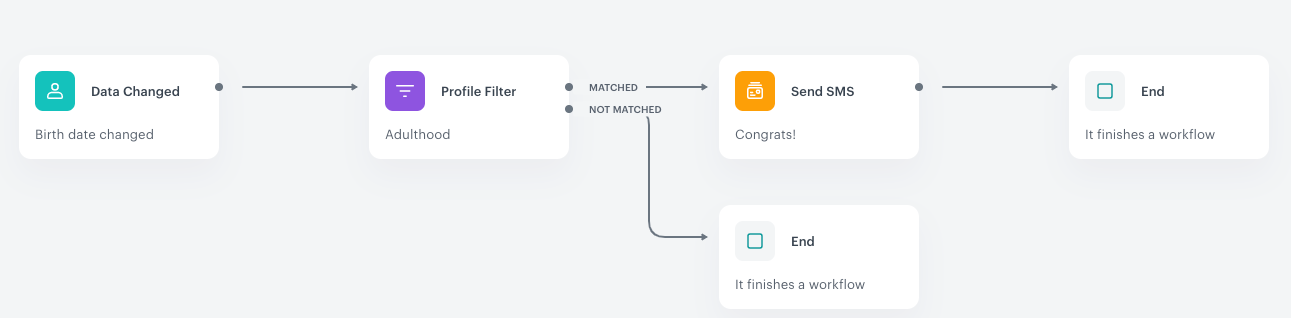
Example of an automation process that uses the Send SMS action
The purpose of this automation is to send a text message with informing a customer about access to special offers.
1. The first step is to add the **Data Changed** trigger that changes the birthdate (without defining a specific date).
2. The next stage of the automation process is the **Profile Filter** node, a condition node, which checks:
- whether the birthdate change meets the requirement of a segmentation that defines customers as adults.
- If customers who meet the above condition have a phone number on their cards (without the phone number this action will not succeed).
3. If customers belong to the segmentation, they proceed to the next stage. A text message is sent to them.
4. When the text message is sent, the process ends.