> Synerise Documentation — Loyalty Guide > > This file contains the complete "Loyalty Guide" section of the Synerise documentation. Each article begins with a top-level "# " heading. The manifest listing all sections is at https://hub.synerise.com/llms-full.txt # Loyalty Guide ## Welcome to the Synerise Loyalty Guide! ...the ultimate guide, on your way to becoming a Synerise Loyalty Master!
Synerise Loyalty Guide
Welcome to the world of loyalty programs where customer-brand connections are reinforced through virtual currency, app integration, gamification, and personalized experiences. As you learn, you'll develop the expertise to design captivating programs for enduring brand success. ### What is the goal of this guide --- This guide is designed to serve as an introduction to loyalty programs in Synerise, their benefits and how to get started. We will explore the different types of loyalty programs, their advantages and disadvantages, and how to set up loyalty program for your business. By the end, you will have a better understanding of how loyalty programs can help your business grow and be successful. **So, let's get started!** ### What will you learn? --- Accomplish our Synerise Loyalty Guide program and be ready to start new level of using Synerise! With **SYNERISE LOYALTY GUIDE** you will learn:

Arrow down iconHow to create and manage a successful loyalty program

Arrow down iconHow and where you have to start you loyalty journey

Arrow down iconWhat types of scenarios you can use
### How to use this guide? --- To get the most out of our guide, don’t skip any lesson and stick to the order we’ve laid out. Our loyalty team experts have carefully prepared the order of the lessons so that it is easy to understand how to prepare the process of creating the loyalty program step by step. In every chapter you will find a few types of content: - **Introduction and basic information** – Read them all to become familiar with the topic. - **Links to our use cases and documentation** - You can find there complete set of information and practical examples of use.
**Enjoy your learning process!** *Synerise Team*

# Lesson 7 Personalized Promotions
Cover illustration for loyalty program lesson 7 on personalized promotions
Personalised promotions represent an innovative approach to marketing, tailored to the dynamic expectations of today's consumers. Their main objective is not only to increase customer loyalty, but also to improve the effectiveness of sales activities. Synerise offers unique flexibility in customising offers, page content and communication, allowing you to respond to the real needs of your customers. The [**Time Optimizer**](/docs/settings/configuration/time-optimizer) tool available in Synerise allows you to tailor the timing of message delivery to each customer's preferences, increasing the effectiveness of personalised campaigns. #### Business goals --- - **Increase customer engagement**: Creating more personalized experiences increases customer engagement, which impacts loyalty and frequency of interactions. - **Flexibility to tailor offers**: The ability to quickly adapt offers to changing market conditions and customer preferences. - **Respond to real customer needs**: Striving to better understand and meet customers' real needs leads to stronger relationships. - **Reach more recipients**: Tailoring the timing of message delivery to each customer's preferences fosters a better understanding of optimal activity periods. - **Increase conversions**: By delivering more personalized and tailored offers, the company aims to increase transaction conversion rates. ## Learning objectives --- In this chapter, you will learn what a **personalized promotion** is, how to configure it effectively and how to **maximize its use.** At the end of the lesson you will find ready-made scenarios with step-by-step implementation instructions.
- Personalized promotions may be also **directed to anonymous customers in stationary stores.** We can recommend promotions on the fly, based on the current contents of the shopping cart and let the cash system print the results on receipt. - Please note that loyalty scenarios incorporating personalized promotions can also include promotions scenarios. If you're planning to implement such scenarios, make sure that you've become familiar with information provided in [**Lesson 4: Promotions&Rewards**](/loyalty/lesson-4/type).
# Lesson 6 Gamification
Cover illustration for loyalty program lesson 6 on gamification
Gamification and loyalty programs are tools that enhance user and customer engagement through different methods. Gamification involves creating interactive tasks that resemble gameplay, encouraging active participation and competition. The Synerise platform allows for creative design of gamification scenarios, utilizing features such as loyalty program levels, coupon allocation, and user rewards for specific actions. These elements can be integrated into automation frameworks, effectively increasing customer engagement through intriguing interactions and motivating activity. Therefore, using the Synerise platform enables seamless integration of gamification and loyalty programs to increase user engagement. #### Business goals --- - **Enhancing user activity**: Gamification can encourage users to engage more frequently by creating appealing scenarios and challenges, promoting desired behaviors such as regular application usage. - **Promoting desired behaviors**: Gamification can motivate users towards undertaking desired actions, such as regular application usage, participation in community activities, and content sharing. - **Increasing user retention**: Introducing gamification elements into applications can extend the time users spend within them, contributing to sustained platform engagement over a longer period of time. #### Using gamification in loyalty programs Gamification in loyalty programs can be utilized to boost customer engagement and motivate product or service usage. Here are four aspects where gamification can be effectively applied in loyalty programs: - **Rewarding achievements**: Employing gamification elements allows loyalty programs to reward customers not just for purchases but also for achieving specific goals, such as frequent service usage, contest participation, or referring new customers. - **Levels and badges**: Implementing levels or badges systems rewards customers for their achievements or engagement. For example, regular customers may advance to higher levels, granting them access to exclusive rewards or benefits. - **Challenges and competition** - Loyalty programs can offer challenges and contests to incentivize customers to use products or services more frequently. For instance, a customer may receive bonus points for completing a specific task or achieving the best results in a contest. - **Community and collaboration** - Gamification can be used to build a community around the loyalty program by encouraging customers to collaborate, share experiences, and participate in community activities, thereby creating a bond between the brand and its customers. By applying these gamification elements, loyalty programs can become more attractive to customers and more effectively build long-term relationships with them. ## Learning objectives --- In this lesson, you will learn about the components of loyalty **programs based on gamification**, the stages of their creation, and how to accurately construct a loyalty program scenario based on **renewable events**. # Lesson 1 Earn mechanism
Cover illustration for loyalty program lesson 1 on earning points
Our journey into loyalty programs starts with an introduction to the mechanism of earning points. This includes the principles on which points are awarded to customers. The purpose of this mechanism is to foster commitment and loyalty among customers, which often leads to increased interest in the company's products and services. #### Business goals Earn mechanism allows businesses to set up and manage a system where customers accumulate points or rewards based on their interactions, purchases, or other predefined actions. The flexibility of the Synerise platform ensures that the earning criteria can be tailored to align with a business's unique objectives and customer preferences. Integrated with real-time analysis, the earn program also provides valuable insights into customer behaviors, allowing brands to fine-tune their strategies for maximum impact. - **Build customer engagement**: Create a points reward system to encourage customers to actively participate in the loyalty program. - **Increasing customer loyalty**: By consciously and effectively applying the points earning mechanism, the company aims to retain existing customers and increase their brand loyalty. - **Increasing purchase frequency**: By rewarding customers for purchase activity, the company aims to increase purchase frequency and transaction value. - **Building customer relationships**: The points earning mechanism aims not only to reward customers, but also to build lasting relationships with them by understanding their needs and preferences. - **Building a positive brand image**: Creating a fair, attractive and transparent points earning mechanism contributes to building a positive brand image among customers. ## Learning objectives --- This chapter explains how the **points earning mechanism** works in Synerise and how to create **tiers for loyalty programs**. It also provides information on different **points schemes** that can be used for loyalty programs. The chapter concludes with practical examples of how to use the points earning mechanism. # Lesson 4 Promotions
Cover illustration for loyalty program lesson 4 on promotions and rewards
Whether you're a business owner or a consumer, promotions and rewards probably matter a lot to you. In this lesson, we'll cover both techniques and learn how to implement and effectively utilize them in a loyalty program. Synerise offers the ability to create promotional campaigns, distribute personalized rewards, and conduct real-time analysis to measure their effectiveness. It provides comprehensive management and monitoring of your marketing strategies. #### Business goals --- - **Increasing sales**: Promotions can be an effective tool to stimulate sales by attracting new customers, encouraging repeat purchases, and increasing the value of the shopping cart. - **Customer activation**: Rewards are an excellent way to activate customers, especially those who have been passive or infrequently using your services. Unique offers and discounts can motivate them to re-engage with the brand. - **Increasing brand awareness**: Through campaigns based on promotions and rewards, a company can increase brand awareness, reaching new audiences and building a positive image through favorable offers. - **Promoting new products or services**: Including new products and services in promotional campaigns promotes them and creates an attractive opportunity for customers to try them out. ## Learning objectives --- In this chapter, we will discuss different **types of promotions** and rewards available in Synerise and the **requirements for their implementation**. In the final section, we will present example scenarios of using promotions in loyalty programs, showcasing practical applications and interesting examples.
Please note that loyalty scenarios incorporating vouchers and promotions can also include the mechanism of earning and burning points. If you're planning to employ such scenarios, ensure that you've become familiar with information provided in [**Lesson 1: Earn mechanism**](/loyalty/lesson-1/earn-mechanism) and in [**Lesson 2: Points expiration**](/loyalty/lesson-2/points-expiration).
# Lesson 3 Transferring points
Cover illustration for loyalty program lesson 3 on points transfer
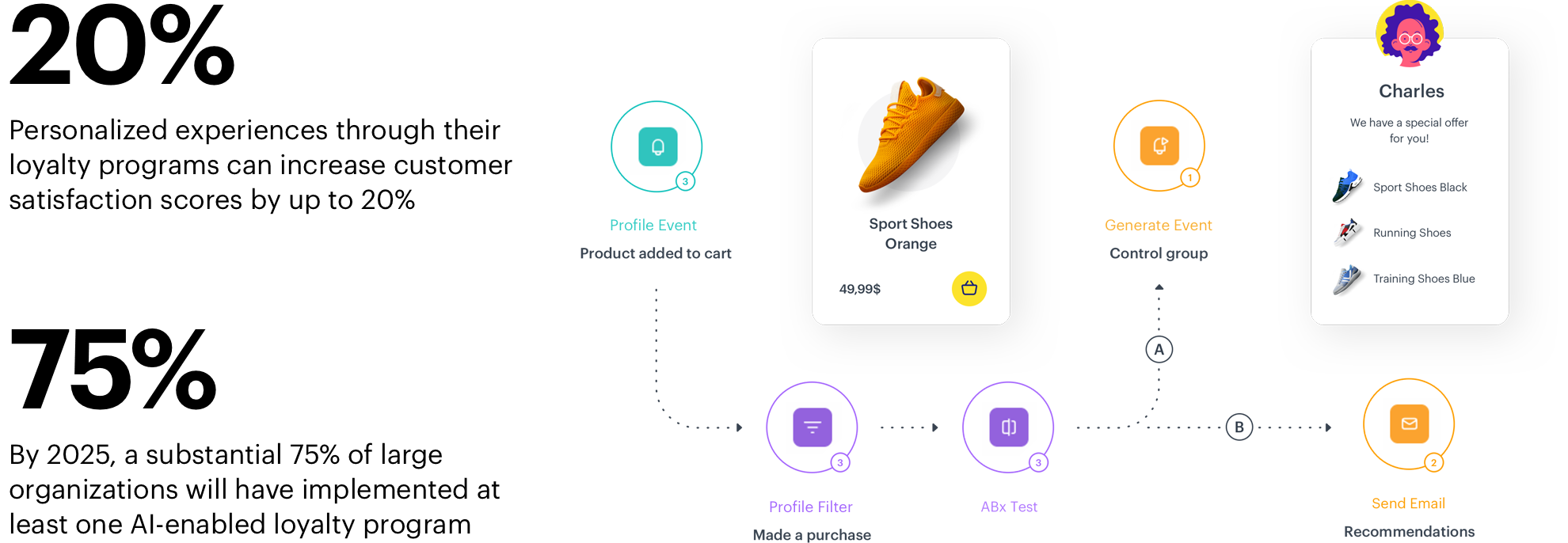
Adding unique features to a loyalty program presents an opportunity to engage more active users. Loyalty points earned by a customer are usually redeemed for products, discounts or rewards. However, with the point transfer feature, they can also be sent to other users' accounts. In the Synerise ecosystem, users can easily transfer points between each other, which promotes user interaction and builds an engaged customer community. #### Business goals --- - **Strengthen community and family relationships**: The transfer of loyalty points between users fosters an engaged community. This encourages loyalty program participants to share benefits and motivate each other to be active together. Program participants can also be a family group or a group of friends, which further motivates interaction. - **Increasing program appeal**: Unusual features like points transfer make the loyalty program more appealing to users, which can attract new customers and maintain the loyalty of existing ones. - **Boost user activity**: The ability to transfer points acts as an additional stimulus for user activity to share their earned benefits with others. - **Analysis of behavior**: The transfer of points between users generates data on customers' interactions and preferences. This enables a better understanding of their behavior and adaptation of the marketing strategy to it. ## Learning objectives --- This chapter explains how Synerise facilitates the **transfer of points between users** and provides guidance on **configuring the points transfer** mechanism. # STEP 1 Loyalty in numbers Loyalty programs are very often incorrectly identified with more or less complicated discount systems. While the transactional approach of converting transaction values into available discounts is indeed effective, it is important to note that it is not the sole reason why customers join the program. ## More than just discounts --- Many studies suggest that exclusive rewards available only to club participants are just as significant as discounts and coupons obtained by customers. The next places in rankings represent the prizes that are challenging to assign a tangible value. What is particularly intriguing is that these prizes are not significantly less important. - Discounts and coupons - **93%** 1 - Loyalty awards - **91%** 1 - Early or exclusive access to offers and services - **86%** 1 - A sense of belonging to the brand community - **59%** 1 - Unlocking additional content - **51%** 1 ## Key numbers --- You are already familiar with loyalty programs, but let's explore why they are crucial. Loyalty programs are increasingly becoming a fundamental aspect of business strategies for online businesses, both big and small, as demonstrated by various studies and reports. - Personalized experiences through their loyalty programs can increase customer satisfaction scores by up to **20%**. 2 - 84% of consumers are more likely to choose retailers that offer a loyalty program. 3 - By 2025, a substantial 75% of large organizations will have implemented at least one AI-driven loyalty program. 4
Loyalty with numbers
Statistic from loyalty programs
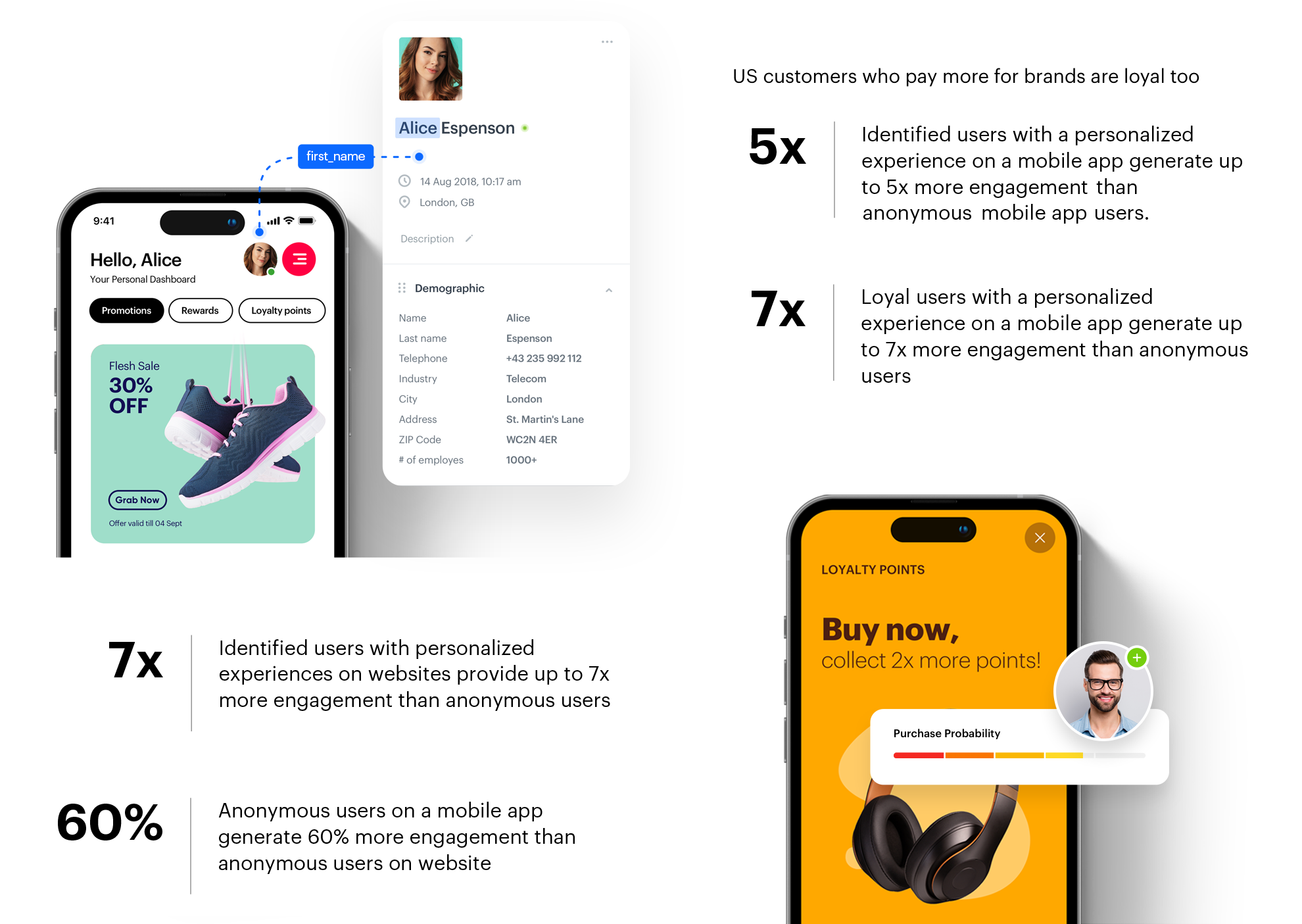
## Customer engagement --- The advantages of loyalty programs are supported by the data we have collected and analyzed. This data proves that consistent focus on customer engagement and satisfaction is crucial in reducing churn and boosting sales. Remember that engaged customers are not only more likely to actively participate in loyalty programs but also become loyal advocates for your brand. As you can see from the attached figure, our customers' experience shows that the key to success is to engage users and to transition them from being anonymous to being actively connected with the brand.
Statistic based on data gathered by Synerise
Based on data gathered by Synerise in 2023
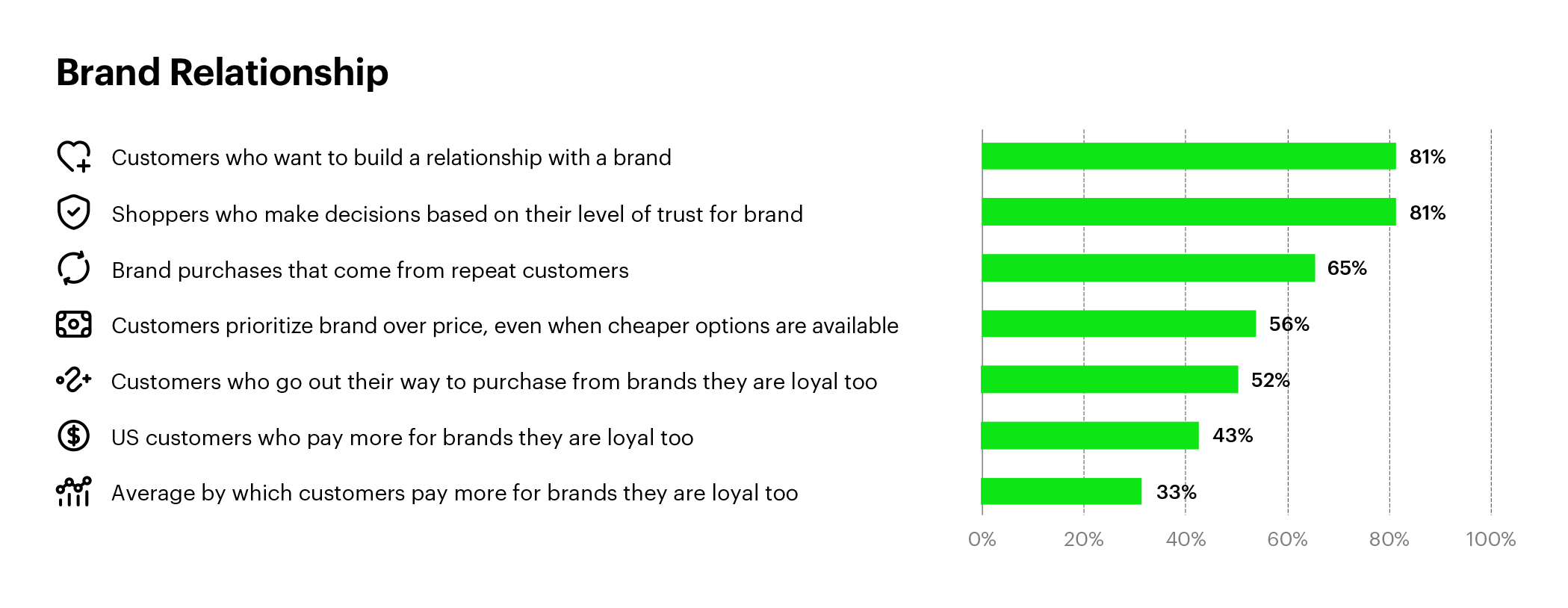
### Brand loyalty really matters --- Customer engagement increases as the brand strengthens. Community engagement, consistent values, language, and company actions all play a role. Therefore, a good loyalty program should align with the brand, not the other way around.
Statistic based on data gathered by Synerise
Based on data gathered by Synerise in 2023
From the perspective of the Synerise customers, loyalty programs provide significant business benefits by optimizing costs and driving revenue growth. These programs offer a wide array of advantages, including fast implementation and adaptable analytics tailored to specific requirements. They also enable real-time customer interactions, digitize services, and grant immediate access to reports.
Data and figures are crucial in Synerise. That's why we began our introduction with them and will conclude with them. But before you proceed to the final step, please go to the [**next article**](/loyalty/introduction/questions) with the question section.
--- 1 Source: Insider Intelligence | "eMarketer" raport January 2024 2 Source: McKinsey, "Making Loyalty Pay: Six Lessons from the Innovators." 2023 3 Source: Nielsen, "The Benefits of Rewards" 4 Source: IDC, "FutureScape: Worldwide Retail 2021 Predictions"
# Introduction
Cover illustration for the loyalty program introduction
Loyalisation is a marketing strategy that uses gamification tools to build a lasting relationship between the customer and the brand. A well-developed strategy allows both parties to benefit from joint interactions. The customer receives various benefits and treats the brand as their first choice. The brand, on the other hand, benefits from the predictability and repeatability of purchases. Loyalty is about actions aimed at creating positive emotions between the customer and the brand. This can be achieved through a dedicated loyalty programme or micro-loyalty scenarios. The information in this course will be highly valuable in both cases. ## Why Synerise? --- Synerise enables effective data collection and analysis, as well as personalized communication using artificial intelligence. It also facilitates sending personalized promotions and mobile campaigns within the app. These features make it possible to implement various loyalty projects, from simple scenarios to advanced gamification programs based on customer behavioral profiles. Synerise simplifies the implementation of localization projects tailored to specific business needs. ## What have we prepared and for whom? --- The material is designed for those who want to create or improve a loyalty program. It provides tips for developing business assumptions and important information for the planning stage. Additionally, it explains how to correctly build the data exchange architecture. ## Step by step --- Now that you understand what loyalty programs are and why they are important, it's time to move on to the next stage - **Preparing for their creation.** You will be presented with a list of questions that you need to answer before you start creating your loyalty scenarios, as well as get to know the features of Synerise that will be helpful in this process. We will then describe the main phases of implementing your loyalty program, followed by a focus on data exchange. In this section and in each subsequent lesson, we will guide you through the material step by step. Start with **>>**[**Loyalty in numbers**](/loyalty/introduction/numbers). # Lesson 5 Vouchers
Cover illustration for loyalty program lesson 5 on vouchers
This guide provides comprehensive information on how to fully leverage the potential of vouchers in your marketing strategy, regardless of your level of knowledge. Synerise offers advanced tools for creating, distributing, and managing personalized vouchers, allowing you to tailor offers to the unique behaviors and preferences of your customers. #### Business goals --- - **Increasing sales**: Vouchers can be an effective tool for stimulating sales by attracting new customers, encouraging repeat purchases, and increasing the basket value. - **Customer activation**: Vouchers serve as an excellent means to activate customers, especially those who have been passive or infrequently using the company's services. Unique offers and discounts can motivate them to make a purchase again. - **Brand awareness**: Through voucher-based campaigns, a company can increase its brand awareness, reaching new audiences and building a positive image through advantageous offers. - **Customer loyalty**: Awarding personalized loyalty vouchers can result in retaining current customers and increasing their engagement. - **Promoting new products or services**: Vouchers can be used to promote new products or services, encouraging customers to try them through special offers and discounts. Vouchers in Synerise can be a part of targeted campaigns or a reward for specific user actions. Thanks to integrated analyses, you have a complete insight into how vouchers are used. As a result, within Synerise's loyalty programs, vouchers not only increase sales but also strengthen customer relationships, making them a key component of loyalty-building strategies. ## Learning objectives --- In this lesson, we will focus on describing the **types of vouchers** offered by Synerise. You will also learn how to effectively **create promotional campaigns** based on vouchers. Finally, we will present you with several selected scenarios in which vouchers play a significant role.
Please note that loyalty scenarios, which include vouchers and promotions, can also incorporate the mechanism of earning and redeeming points. If you're planning to employ such scenarios, ensure that you've become familiar with information provided in [**Lesson 1: Earn mechanism**](/loyalty/lesson-1/earn-mechanism) and in [**Lesson 2: Points expiration**](/loyalty/lesson-2/points-expiration).
# Lesson 2 Points expiration
cover photo2
The process of earning points is closely linked to their expiry. When designing a loyalty programme, it is important to establish clear rules for point usage and the duration of their availability. The process of earning points is closely linked to their expiration. When designing a loyalty program, it is important to establish clear rules for point usage and the duration of their availability. In Synerise, you can set one of two ways for your points to expire. Depending on your choice, points will be deleted regularly in batches or automatically according to the expiration date. The advanced analyses and Automation Hub will provide flexibility in loyalty program configuration. #### Business goals - **Stimulating customer activity**: By implementing controlled points expiration, a company can incentivize customers to actively engage in the loyalty program, encouraging regular purchases and participation in promotions. - **Encouraging faster use of points**: Implementing an automatic point deletion mechanism based on expiration dates can motivate customers to use their points faster, which results in increased engagement. - **Managing financial reserve**: The controlled removal of points allows for improved cost control within the loyalty program and a significant reduction in the financial reserve typically required to cover the redemption value of rewards. - **Improved customer relationships**: Clear rules for points expiration contribute to the transparency of the program, which builds customer trust and improves the overall relationship with the brand. - **Alignment of marketing strategy**: Analyzing data related to the points expiration process allows for a better understanding of customer behavior and the adaptation of the marketing strategy to their preferences. ## Learning objectives --- In this chapter, we will explain the point expiration process in Synerise, including how **point expiration is configured** for **rolling cancellation** and **regular batch cancellation**. The final step provides ready-to-use scenarios with concrete examples. # STEP 3 Features and capabilities We know that creating a loyalty program can be a daunting task, so Synerise is the right platform to help you get started. We give the tools and features needed to create a loyalty program that is tailored to every business. With our platform, you can easily set up and manage loyalty points, rewards, discounts, and much more. ### list of features --- Discover the list of features which will help you in building your loyalty program at ease! 1. Earn mechanism 2. Point expiration 3. Transferring points 4. Promotions 5. Vouchers 6. Gamification 7. Personalized promotions 8. Anti-fraud mechanisms 9. Collecting information with surveys 10. Referral scenarios 11. Content delivery personalization 12. Authorization and profile management with lifecycle processes ---
Each of these features can be treated as a separate loyalty program, so we gather all the important and inspiring information about each of these features in separate [**lessons**](/loyalty/#how-to-use-this-guide). Now go to the [**next article**](/loyalty/introduction/implementations) about implementation phases .

# STEP 3 Vouchers or promotions? Vouchers and promotions are essential components of the marketing strategy for companies operating in the dynamic e-commerce environment. Vouchers provide customers with a specific value, serving as a direct incentive to make a purchase. Promotions, on the other hand, are more complex programs that include various forms of communication and a set of rules that allow customers to benefit from purchases. Both tools can significantly impact the success of online activities.
Diagram illustrating the difference between vouchers and promotions
Difference between vouchers and promotions
## Pros and cons --- To make a more informed decision, it is important to consider the key advantages and limitations of both vouchers and promotional campaigns. By accurately comparing these solutions, you can select the most suitable option for your specific needs. | | Voucher: | Promotion: | | --- | --- | --- | | Pros |
  • **Short and simple implementation** - Once the pricing policy and data integration have been established, voucher distribution can begin.
  • **Accessibility** - Most e-commerce engines support voucher mechanisms.
  • **Flexibility** - Synerise offers advanced segmentation capabilities based on behavioral profiles, allowing you to tailor customer-specific scenarios. |
  • **Advanced solutions** - Integration of the Synerise promotion engine with sales systems opens up new possibilities for usage scenarios, a tailor-made solution
  • **Control** - Synerise may keep control over the whole promotion-based scenarios.
  • **Deep personalization of promotions** - The gathered information is used in complex customer journey scenarios with AI support, even for anonymous customers. | | Cons |
  • **Restriction** - You need to maintain the logic of discounts and all metadata outside Synerise.
  • **Voucher monitoring** - To prevent fraud, loss of vouchers oversee the voucher redemption process. |
  • **Implementation time** - Promotions and are more time-consuming and complex to implement.
  • **Cost of implementation** - The financial and time implementation cost is higher than for vouchers.| Arrow down icon **DOCUMENTATION**

    For a more comprehensive understanding of implementing promotions and voucher coupons, we recommend referring to the documentation. - [Implementing promotions](/docs/ai-hub/promotions/introduction-to-promotions) - [Voucher pools](/docs/assets/code-pools) Arrow down icon **BLOG POST**

    Both vouchers and promotional campaigns can be effective if applied correctly. Discover further information regarding [the business comparison between vouchers and promotions](https://www.synerise.com/blog/vouchers-vs-promotions-whats-the-difference) to gain a deeper understanding of the differences and advantages between the two approaches. ---
    You already know the main advantages of vouchers, their types and how to configure them. In the [**final, article**](/loyalty/lesson-5/scenarios) of this lesson, you will explore scenarios for using vouchers.

    # STEP 3 Scenarios You've gained a grasp of the fundamentals of the promotional engine in Synerise. It's time to put that knowledge into practice. In this section, you will delve into selected scenarios that demonstrate the application of promotions for specific products or the entire shopping basket. ## Selected use cases --- Presented below are a series of use cases, each with a brief introduction. Click on the link to access a detailed description, configuration, and preview of each scenario. We encourage you to explore all the cases and apply your acquired knowledge in practical exercises.
    Loyalty program use cases overview illustration
    Arrow down icon **USE CASES**

    This use case focuses on developing a promotion that targets customers with the highest likelihood of purchasing items from the wireless headphones category.

    [**Promotions for customers with high propensity to purchase**](/use-cases/propensity_based_promotion) | Arrow down icon | Arrow down icon **USE CASES**

    This use case outlines the process of crafting a promotion that is tailored to customers' gender by leveraging segmentation methods.

    [**Gender-based promotion**](/use-cases/gender-based-promotion) | Arrow down icon | Arrow down icon **USE CASES**

    This use case involves the creation of a basket promotion where customers can enjoy a 10% discount on their entire purchase, with the exception of alcohol products. The promotion will be triggered when the total value of items in the basket reaches a minimum requirement of $25.

    [**Discount for entire basket**](/use-cases/promotion-for-entire-basket) | Arrow down icon | Arrow down icon **USE CASES**

    This use case describes the process of creating a promotional campaign tailored for newly enrolled loyalty program members. It involves launching a workflow that automatically sends a mobile push notification with information about a 10% discount on the entire cart.

    [**Promotion for the first transaction after joining the loyalty program**](/use-cases/discount-promotion-for-first-transaction) | Arrow down icon | ---
    If you are interested in any of the scenarios but don't have an account with Synerise yet, please reach out to us. We will work together to determine the best plan of action! [**Contact Us**](https://www.synerise.com/contact)
    You have just finished lesson 4 - **Congratulations!** Welcome to [**LESSON 5**](/loyalty/lesson-5), this time we will delve into the topic of vouchers.

    # STEP 4 Scenarios In this section, we will analyze various examples of voucher use within loyalty programs. The following cases will demonstrate how vouchers can effectively build long-term relationships with customers. ## Selected use cases --- We have picked use cases featuring vouchers from our extensive use case library. Clicking on the link will take you to a comprehensive description, configuration details, and scenario preview. We strongly encourage you to explore all the examples and put your knowledge into practice
    Loyalty program use cases overview illustration
    Arrow down icon **USE CASES**

    Recognizing the special milestones of your club members goes beyond celebrating their birthdays; it includes acknowledging their membership anniversaries as well. These significant occasions are excellent opportunities to send them exclusive rewards, such as coupons.

    [**Coupon for membership anniversary**](/use-cases/coupon_for_anniversary) | Arrow down icon | Arrow down icon **USE CASES**

    Improving customer loyalty with special birthday coupons is crucial. In this scenario, we will guide you step-by-step through the process of setting up an email campaign featuring personalized birthday coupons.

    [**Birthday email with coupon**](/use-cases/birthday-coupon) | Arrow down icon | Arrow down icon **USE CASES**

    Personalize communication and target promotions based on customer segmentation to drive revenue, rather than sending generic offers to all customers. Effective targeting of vouchers to specific recipients at the right time produces better results than distributing irrelevant offers to a broad audience.

    [**Voucher assignment based on average basket value**](/use-cases/vouchers-depending-on-aov) | Arrow down icon | Arrow down icon **USE CASES**

    In this scenario, you will discover how to create a monitoring system for all coupon pools in your workspace. The system will alert you whenever the number of codes in a coupon pool falls below a specified threshold.

    [**Voucher pool alert**](/use-cases/voucherpools) | Arrow down icon | ---
    If you are interested in any of the scenarios but don't have an account with Synerise yet, please reach out to us. We will work together to determine the best plan of action! [**Contact Us**](https://www.synerise.com/contact)
    You have just finished lesson 5 - **Congratulations!** Welcome to [**LESSON 6**](/loyalty/lesson-6), in which we will delve into the topic of gamification.

    # STEP 2 Scenarios --- You are already familiar with the process of transferring points between users and its business purpose. This section provides a pre-made scenario for using this functionality, along with a detailed implementation description. ## Selected use cases --- Below is a use case with a brief introduction. Clicking the link will take you to a detailed description, configuration, and preview of the scenario on the Synerise DEMO version.
    Loyalty program use cases overview illustration
    Arrow down icon **USE CASES**

    In this use case you will get to know how to integrate the mechanism of loyalty points transfer in your mobile application. For better user experience, it will be enriched with mobile push notification for the recipient of points.

    [**Transfer loyalty points between customers**](/use-cases/loyalty-points-transfer-with-push) | Arrow down icon | ---
    If you are interested in any of the scenarios but don't have an account with Synerise yet, please reach out to us. We will work together to determine the best plan of action! [**Contact Us**](https://www.synerise.com/contact)
    You have just finished lesson 3 - **Congratulations!** Welcome to [**LESSON 4**](/loyalty/lesson-4), where we will dive into the topic of promotions.

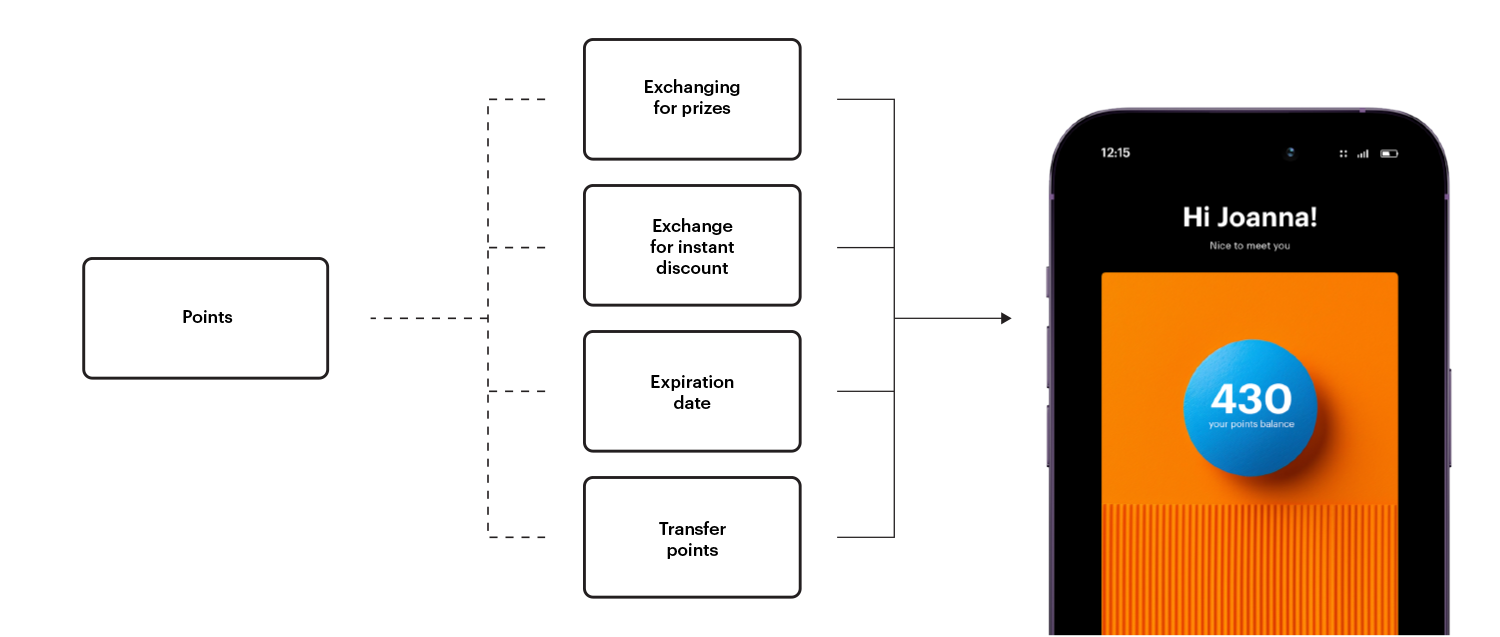
    # STEP 1 Points expiration Every loyalty program faces a serious challenge of establishing rules related to point redemption. Consistent and clear rules help to motivate participants to be more active and are the basis for monitoring the effectiveness of the chosen scenario. ## What is points expiration process? --- The points expiration process involves setting an expiration date for accumulated points or rewards within a loyalty program. This means that points or rewards have a specific expiration date, after which they cease to be available or loose their value. ## What happens with the points? When planning a loyalty program, we can specify an expiration date for the points, as well as how they can be used or redeemed. Synerise offers several options that can be implemented in your loyalty program. The figure below shows a list of actions that can reduce the balance of points in a customer's account.
    Diagram showing ways of decreasing loyalty points
    Ways of decreasing loyalty points
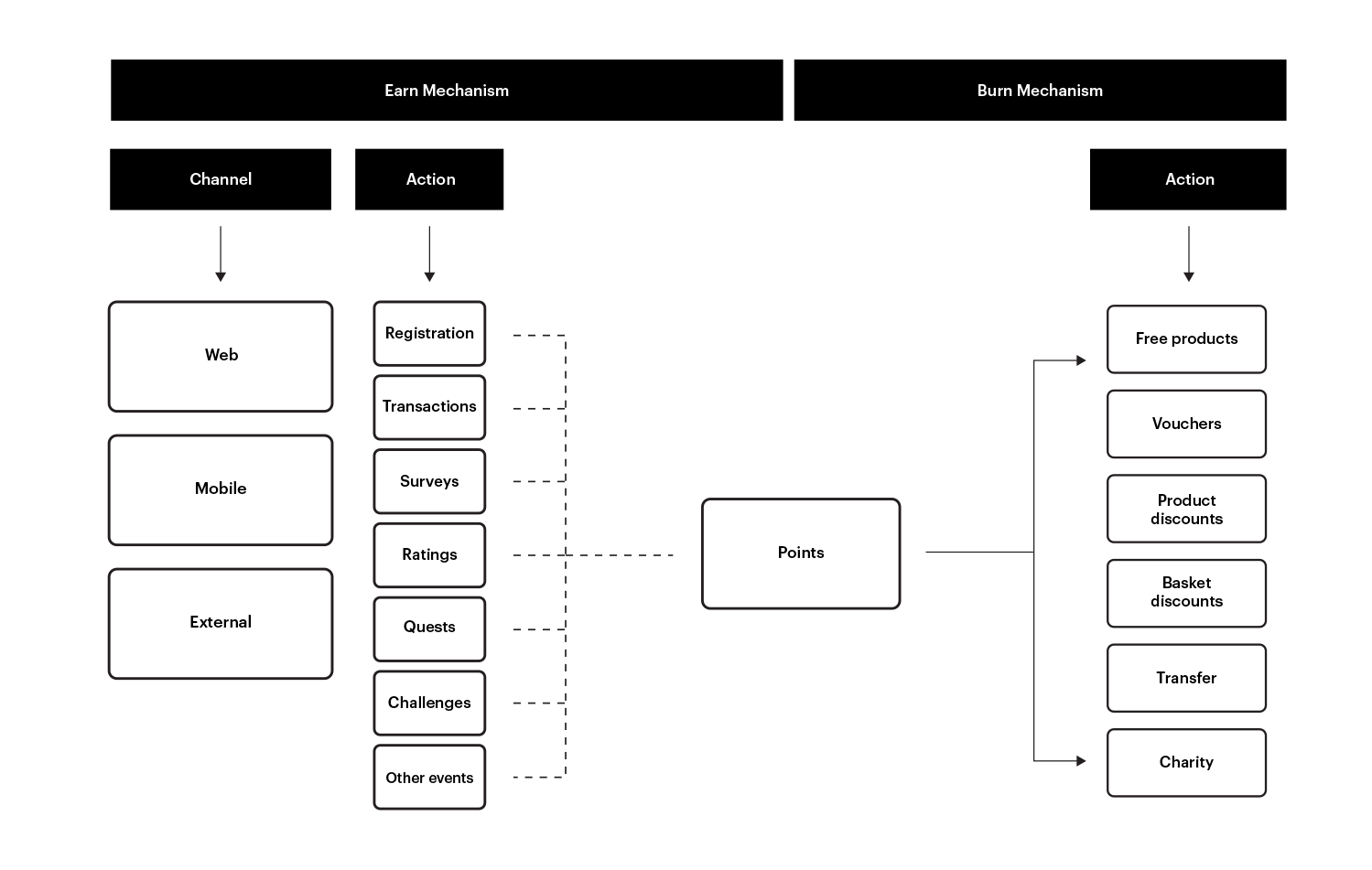
    Depending on the loyalty program scenario, points can be reduced by: - **Exchange for rewards** - In this case, customers receive a selected reward from the pool for a certain number of points. - **Exchange for instant discount** - This option lets customers decide how many points they want to exchange into money while paying for purchased products. - **Expiry of points** - In this case, to reduce the points accumulated by customers, you can impose expiration date for the points; we will describe this process in detail in [STEP 2](/loyalty/lesson-2/points-expiration-process) of this lesson. - **Transfer of points** - In this case, points can be transferred to other users. More about this topic in [Lesson 3](/loyalty/lesson-3). ---
    You already know what is points expiration, in the [**next article**](/loyalty/lesson-2/points-expiration-process) you will learn more about the configuration of the whole process.

    # STEP 2 Scoring methodology In the previous article, we discussed the earn mechanism and its significance for the loyalty program. In this section, we will describe the models for collecting points. The models for collecting points in a loyalty program vary in complexity and flexibility. Selecting the appropriate model is crucial for attracting and retaining loyal customers. ## Earning points mechanism in Synerise --- In the Synerise platform, the earn mechanism is configurable in two models: - **Threshold-based model** - **Point collection-based model** The differences between them relate to how the activity is recorded, the points awarded and the rewards. Please refer to the table below for a detailed breakdown of each model. | | Threshold-based model | Point collection-based model | --- | --- | --- | | **Assumptions** | Simpler, less customers activities. | More options and rewards, frequent customers interactions. | **Reward** | The higher the tier, the better the rewards; smaller pool of rewards.
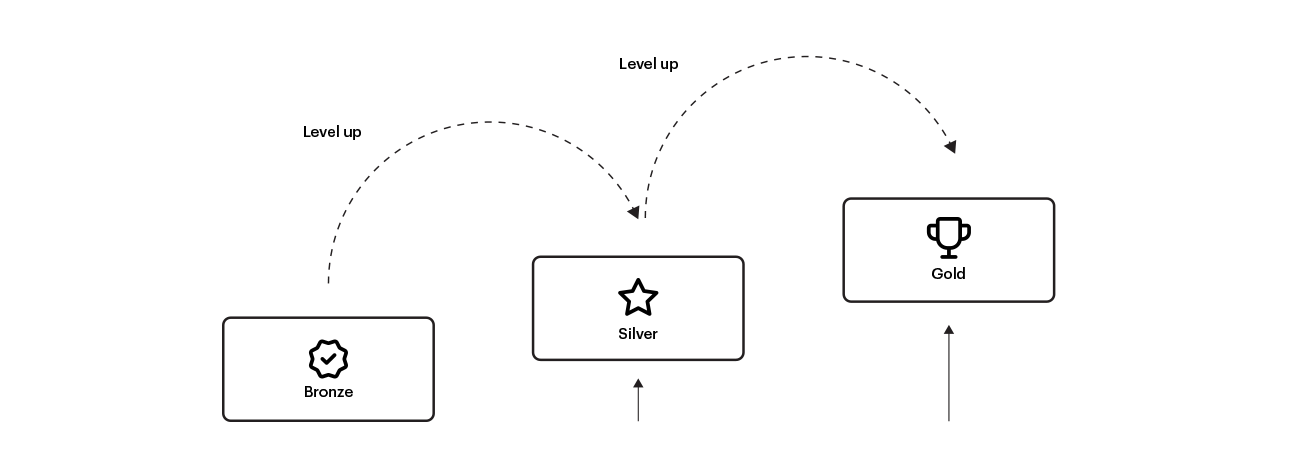
    | Same conditions for everyone, points redeemable for free products or discounts.| ## Threshold-based model --- The scoring for thresholds is calculated in similar way to the points balance, though the rules are usually more simple. You can build it on any activity-based metric, but majority of solutions choose spendings or/and purchasing frequency. ### What is a tiered scenario --- Tiered scenarios are loyalty programs in which customers earn successive layers, or levels based on calculated scoring.
    Diagram showing tier structure in a loyalty program
    Tiers in loyalty program
    The loyalty model presented offers customers a graduated reward structure, which in turn encourages them to maintain engagement. In tiered scenarios, each successive **tier represents a higher level of loyalty** and may be associated with more exclusive benefits, discounts or rewards. Advancement to a higher level may be dependent on achieving a certain number of points, purchase frequency, loyalty program activity or other specified criteria. These types of loyalty programs aim to create a more dynamic and attractive experience for customers, who **gain additional value each time they advance to a higher level**. Tiered scenarios are becoming increasingly popular due to their effectiveness in shaping positive customer relationships and increasing customer engagement over the long term. ### Tiers conditions types Tiered scenarios can be built based on a variety of customer activities, both purchase-related and other customer activities. Some of the most popular include: - Transactions value, - Customer seniority, - Customer activity (such as adding a review, playing a video, liking a page, and more), - Frequency of purchases, - Marketing consents. The selection of factors to consider for layering is an individualized approach that should be considered as a customer engagement factor across multiple levels, not solely focused on the purchasing aspect. Arrow down icon **USE CASES**

    In [Tiered loyalty program](/use-cases/loyalty-color-schemas) use case customers will be assigned to one of the four levels (tiers) of the loyalty program based on the total balance value (transactions value minus the value of returns) from the last 365 days. Each tier is represented by a color. ## Point collection-based model --- Synerise offers two layers of schemes for building a point system. - **The basic points scheme** - **Promotional points actions** The differences between the schemes relate to how points are accrued in loyalty programs. The precise distinction of each mechanism is described below. ### The basic points scheme --- The **basic points scheme** covers the fundamental rules for earning points, typically based on the amount spent but in general used for rules that are very rarely modified or do not change at all. This scoring model is effective when the program’s rules and stages are clearly defined. Arrow down icon **USE CASES**

    We encourage you to check our use case [Loyalty programs basics](/use-cases/loyalty-programs-basics). In this use case, we will present a basic schema for building loyalty program, which is the necessary first step you have to make in the beginning if you wish to calculate points for purchased products. It might be treated as the basic loyalty program as a whole! ### Promotional points actions --- A promotional points-based scheme focuses on adding points for specific actions, customer activities. Examples of such activities that can be taken into account in the loyalty program are: - Product page view, - Buying a specific product, category or brand., - Newsletter subscription, - After-sales survey submission. Without any coding, based on the Synerise possibilities we can develop rules for calculating points for such activities. This model is particularly dedicated to limited-time or exclusive offers. Arrow down icon **USE CASES**

    Check an example configuration in [Extra points for purchase](/use-cases/loyalty-points-for-category) from specific category during specific time. In this use case, purchase from the Christmas category during the pre-Christmas weekend are double-awarded. ## Monitoring of points balance --- A reminder of the points balance at each stage of the loyalty program is very important, so that we can avoid users getting stuck at one of the loyalty stages. Ongoing monitoring increases the efficiency of loyalty program by enabling any points-related issues to be resolved quickly. You can use [API methods](https://hub.synerise.com/api-reference/analytics-suite#operation/calculateExpressionAsClientGET) to display the points balance. One common issue that companies encounter is customers failing to utilize their loyalty points. To address this, customers can receive an alert within the app reminding them of the upcoming expiration date of their points and the remaining time until they expire. Arrow down icon **USE CASES**

    Read the [In-app point balance reminder](/use-cases/in-app-point-balance-reminder) use case in which we show how to prepare an alert in a mobile app.
    --- You already know how scoring works in Synerise, in the [**next article**](/loyalty/lesson-1/scenarios) you will learn more about scenarios to put this knowledge into practice.

    # STEP 2 Questions you need to answer --- To develop a perfect loyalty program, numerous critical questions must be tackled. It is crucial to analyze your business and its position before exploring the best loyalty scenarios. This will help you better tailor your offers to your current business objectives, avoiding duplicating the most intriguing and advanced loyalty programs that may not fit your company’s real needs. ### List of suggested questions --- Below you will find suggestions for questions that will be the best to get you started. 1. Who are my customers? 2. Do I have enough insights? 2. What data do I want to collect? 3. Do I know a journey of my customers? 4. Do I have a ready strategy? If not – am I able to prepare it by myself? 5. What are the main goals of my program? 6. How should I make my program unique, attractive and engaging? 7. Should I implement an earn and burn points process in addition to tiers, or should I only focus on implementing tiers? Which activities or behaviors should be the basis for earning points in this program? 8. What rewards would I like to offer my customers? 9. Do I have a complete team for a start? 10. What amount of loyalty points would you assign for defined customers activities? 11. Do I see any potential in cooperation with business partners outside my own company? 12. What would be my MVP (Minimum Viable Product)? 13. Which business processes would I like to automate? 14. How much time do I have until the first public release? ---
    Effective loyalty programs require careful consideration of these questions. Before proceeding to the [**next article**](/loyalty/introduction/features) with Synerise's functionality, take a moment to carefully answer these questions.

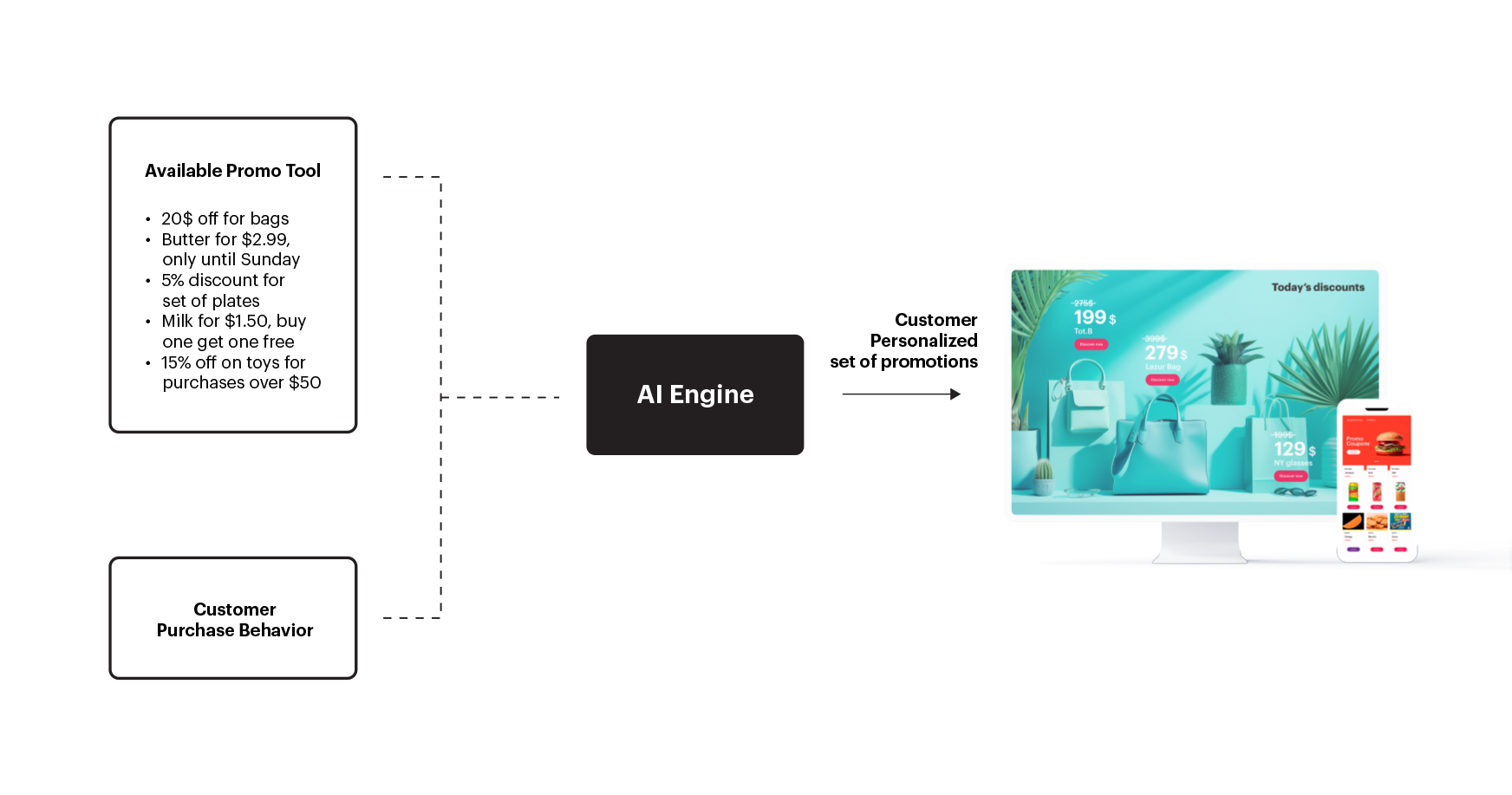
    # STEP 2 Create personalized promotions In the previous chapter, we introduced the mechanism behind personalized promotions in Synerise. Here, you will find links to all resources related to configuring and managing personalized promotions. ## Configuring candidates --- We begin with creating [regular promotions](/loyalty/lesson-4/type) that will be candidates for personalized promotions. Then, the AI engine sorts this list in real time from most interesting to least interesting, selecting the top items according to the business configuration - the number of slots, filters, and availability. ## Promotions management --- On the list of personalized promotions in the Synerise platform, you can activate, edit, duplicate, and delete personalized promotion campaigns. Arrow down icon **DOCUMENTATION**

    For more information on personalized promotion management, see ["Managing personalized promotions"](/docs/ai-hub/personalized-promotions/managing-ai-promotions). ## Distributing and displaying personalized promotions --- Personalized promotions can be displayed in many channels such as digital signage in your point of sales, in mobile application, and website and they can be distributed at a given time of a customer journey. - You can distribute them [on check in, check out, or on a mobile application](/docs/ai-hub/personalized-promotions/introduction-to-ai-promotions#distributing-promotions) - You can [display them using API or through the Documents feature](/docs/ai-hub/personalized-promotions/introduction-to-ai-promotions#displaying-promotions) The promotion can be the same for all channels or different, depending on the business decision and the availability of promotions in a particular channel. Arrow down icon **DOCUMENTATION**

    For more information, see ["Implementing personalized promotions"](/docs/ai-hub/personalized-promotions/introduction-to-ai-promotions). ---
    In this part of Lesson 7 you learnt about the process of creating personalized promotions in Synerise, in the [**final step**](/loyalty/lesson-7/Scenarios) of this lesson we will explore scenarios that use this feature.

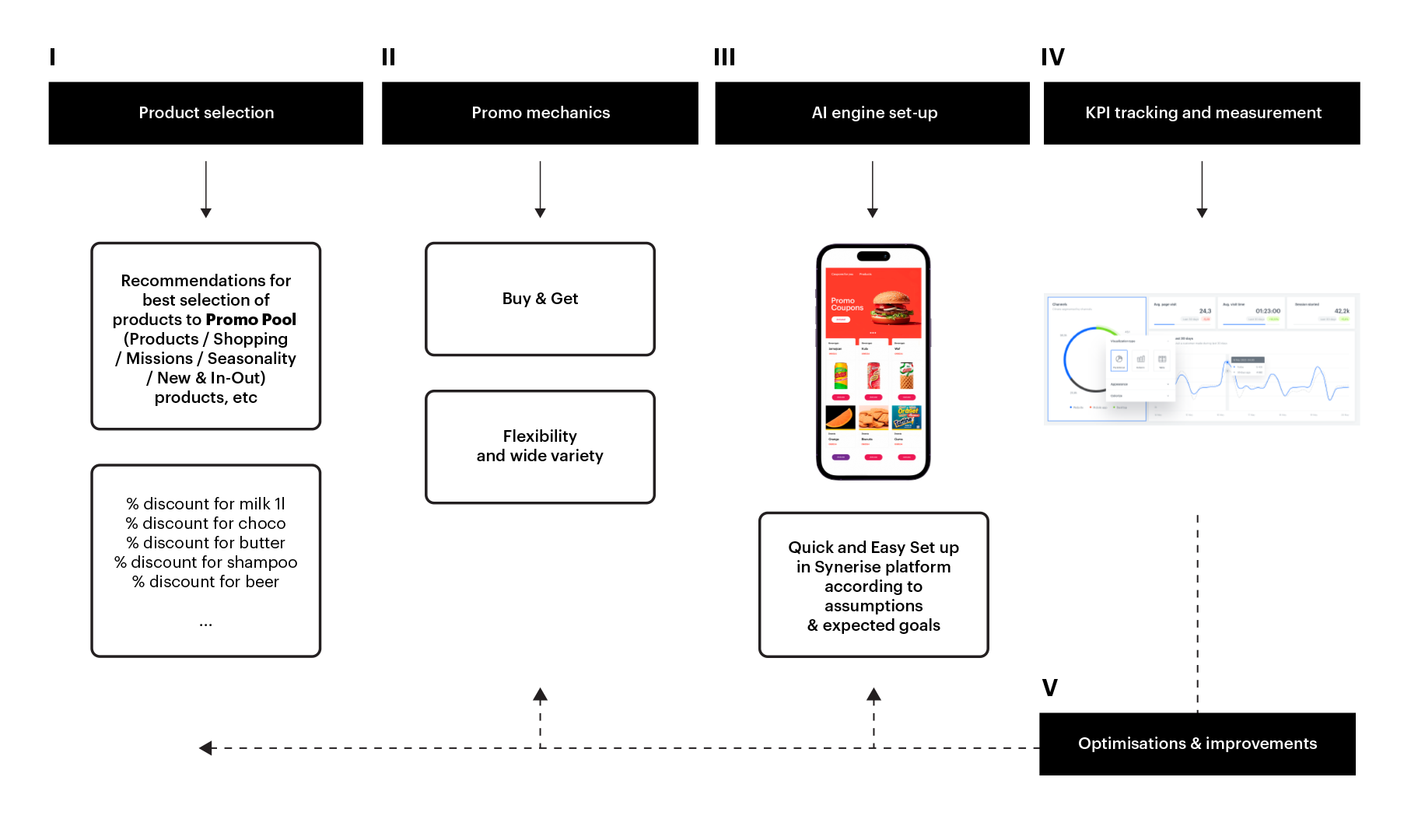
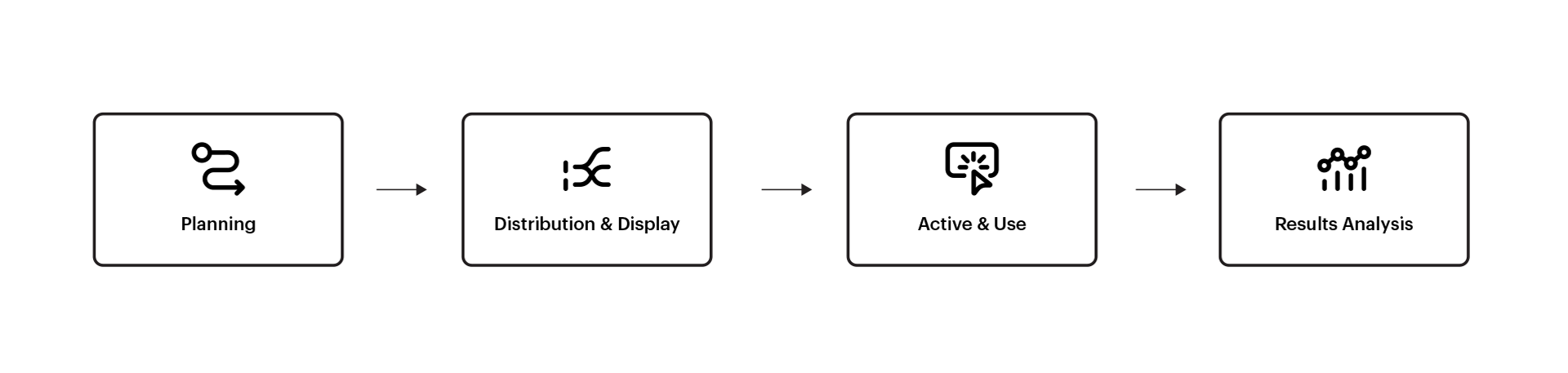
    # STEP 1 Promotion Marketing strategies and initiatives aimed at encouraging customers to make purchases and increase engagement with the brand are precisely what promotional programs are about. Within these activities, customers are offered various benefits, such as discounts, promotions, rewards, coupons, or loyalty points. ## How do promotions work --- The mechanism behind promotions is intuitive and based on a multi-step process - creation, distribution and activation of promotions, analysis of results and effectiveness. You can see a simplified process in the diagram below, with a detailed description of the operation beneath it.
    Diagram illustrating the loyalty promotion process
    Promotion process
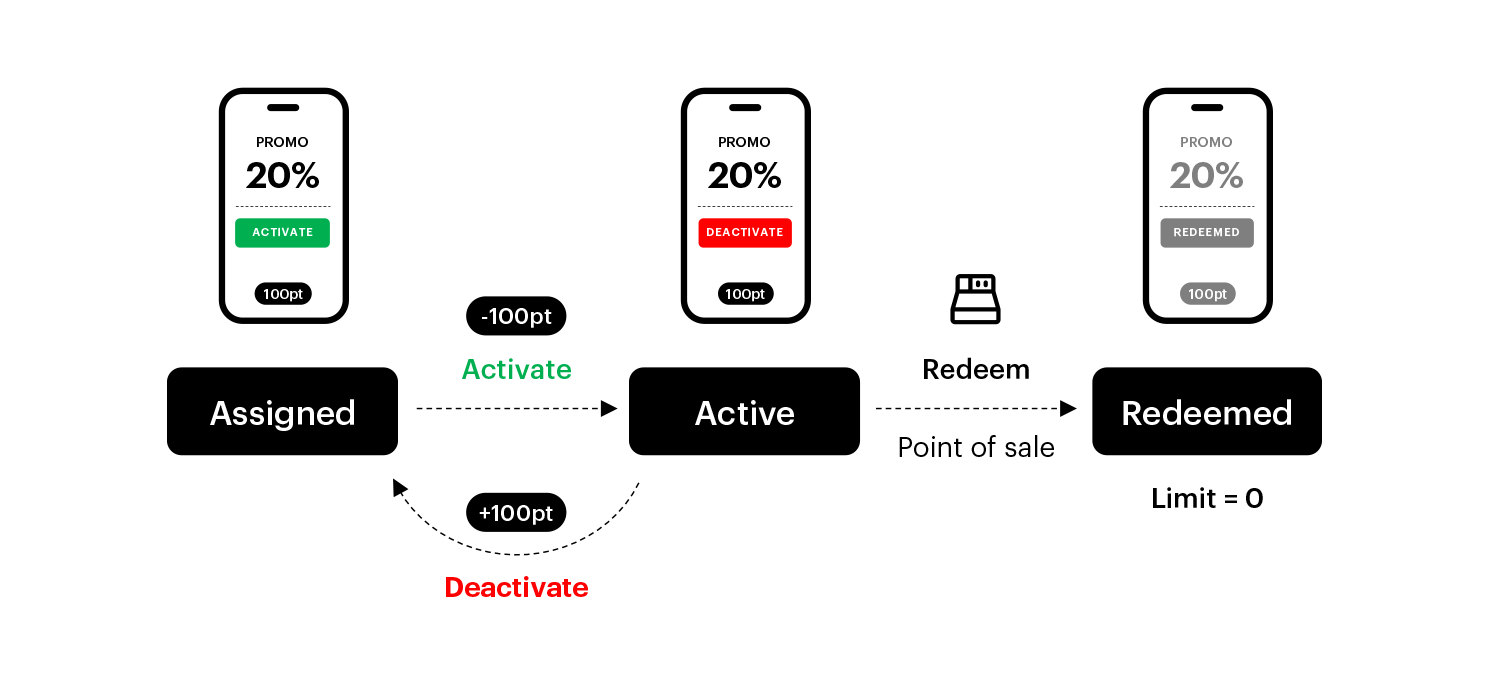
    ### STAGE 1: Planning - **Defining promotion objectives**: The first step is to establish clear objectives for the promotion, such as increasing sales, building brand awareness, acquiring new customers, or enhancing engagement with existing ones. - **Target audience research**: Understanding the needs, preferences, and behaviors of customers through analysis and segmentation of the target audience is crucial. This enables more effective customization of the promotion to meet their needs. - **Budget and resources**: Assessing the available budget and resources, including financial means, human resources, and technological assets, that can be allocated for the promotion is essential. ### STAGE 2: Distribution & displaying At this stage, we decide where to distribute our promotion or reward, for which we can use any channel, such as email, mobile application, websites. Depending on the chosen display channel, you will need to implement an appropriate method for delivering the solution. Arrow down icon **DOCUMENTATION**

    For more information, check our article about [displaying promotions](/docs/ai-hub/promotions/introduction-to-promotions#displaying-promotions) section. ### STAGE 3: Activation & usage Promotions are activated by the user at the moment of displaying the offer through our selected communication channel, adopting one of several activation states. The states always exist in a given end-user context. The same promotion may have different states for different users. The following graphic presents all these states along with their explanations Promotion statuses in Synerise database - **Assigned** – If the promotion meets all the display conditions, and user belongs to promotion's segment, the promotion receives the status of “assigned" for this user. - **Active** – The "Active" status is given to a promotion that was assigned to and activated by end-user. Activation may redeem user's points or be free of charge, depending on configuration of the promotion. - **Redeemed** – Some promotions have usage limits; if a customer utilizes it, the promotion moves to the “redeem” status, indicating that the personalized promotion cannot be activated and used again by this specific user. In Synerise, promotions do not have a visible code to the user; necessary information is communicated between the cash/commerce system and Synerise. The only crucial element is identification of the customer at the time of purchase unless you want the promotion to be used by anyone. For complete reference of promotion statuses, go to the ["Promotion statuses" section](/docs/ai-hub/promotions/introduction-to-promotions#promotion-statuses) ### STAGE 4: Results analysis Regularly tracking and analyzing promotional results, such as sales metrics, customer engagement, ROI, or website traffic growth, is critical. It helps gauge the effectiveness of promotional spend and assess the success of the promotion. Based on the data obtained, conclusions and recommendations can be drawn for further marketing activities and possible improvements for future promotions. Arrow down icon **DOCUMENTATION**

    We recommend using [reports](/docs/analytics/reports/introduction-to-reports) and analytical [dashboards](/docs/analytics/analytics-dashboard/introduction-to-dashboards) for monitoring of promotions. We recommend using reports and analytical dashboards for monitoring of promotions. ## Promotion Types --- Synerise offers various types of promotions that can be tailored to meet individual needs and the marketing strategy of a company. Here are some of the types of promotions available in Synerise: | | Description | Example | --- | --- | --- | | **Discounts and rebates** | Discounts and price reductions are a popular form of promotion where the customer receives a reduced price on a product or service. They are attractive to customers looking for price opportunities and can serve as a strong incentive to purchase. Discounts can be given as a percentage or fixed amount, offering flexibility in tailoring offers to different products and situations. | **Example**: *Enjoy our sale! Receive a 20% discount on all products in our online store!* | | **User segment promotions** | These promotions target customers who meet specific demographic criteria, purchasing behaviors, or have similar product preferences. They are characterized by offering personalized discounts or reductions that match their individual needs and interests. | **Example**: *Super offer for Women's Day, today only ladies buy all products 10% cheaper!* | | **Promotions tailored to location and channel** | These promotions are optimized for the customer's location and purchase channel. They offer unique benefits or discounts to customers who shop in a specific location, such as a newly opened store in a particular city, or through a specific shopping channel, such as a mobile app. This makes promotions more effective because they are tailored to the specific preferences and behaviors of customers. | **Example**: *This weekend only, in our newly opened store in Warsaw, save 10% on purchases over 200 PLN through our mobile app!* | | **Loyalty point promotions** | Loyalty programs reward customers for frequent purchases or other desired actions. They build long-term relationships with customers by rewarding them for their participation in the program. | **Example**: *Exchange your 500 points for a 30% discount on your next purchase!* | | **Rewards and gifts** | Promotions involving rewards and gifts offer customers free products, samples, gadgets, or other rewards for specific actions. They are an effective way to encourage customers to make larger purchases by offering additional benefits. | **Example**: *Try our new products for free! Get a mini version of our new face cream after a purchase over $100!* | | **Time-limited promotions** | Time-limited promotions are special offers designed to capture customers' attention and incentivize them to make an immediate purchase. These promotions can generate sales increases in a short period of time and can be used to build brand awareness. | **Example**: *Time for a flash sale! For the next 24 hours only, all shoes in our store will be 30% off.* | | **Personalized offers** | Personalized offers are created specifically for individual customers, taking into account their preferences, purchase history, behavior and other factors. They are a powerful tool for building relationships with customers by offering them products and promotions that are more relevant to them. | **Example**: *We're impressed with your recent purchase of our new smartphone! We have something special for you: a 20% discount on accessories from the same brand that perfectly match your new device.* |
    Promotion types in Synerise can be tailored to different marketing objectives and business strategies. They can also be combined to achieve the desired marketing results more effectively.
    ---
    Now you know how we defined promotions in Synerise, in the [**next article**](/loyalty/lesson-4/type) we will show you how to create one of them.

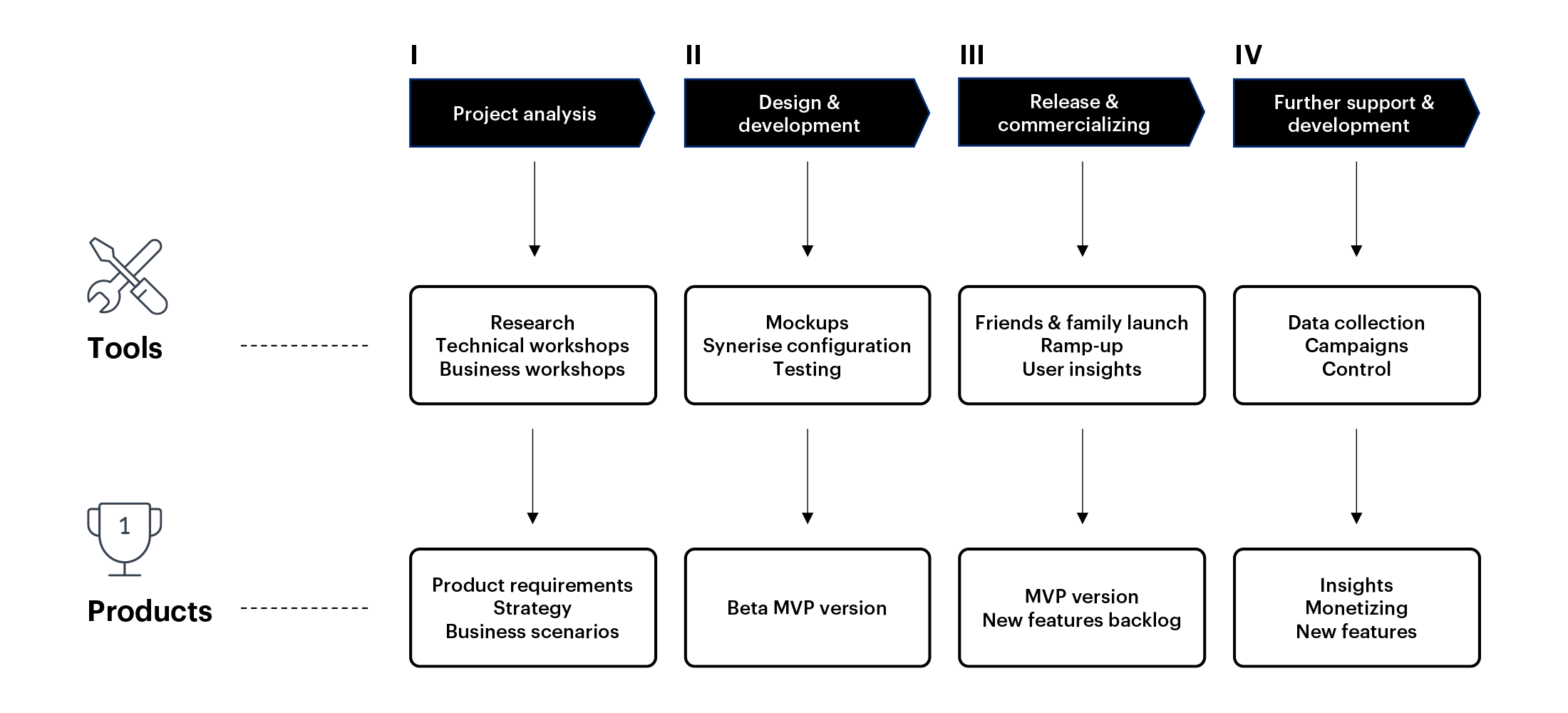
    # STEP 4 Phases of implementation Implementing a loyalty program for your business is an exciting and challenging task. The process involves several phases, each requiring careful planning and execution. By understanding the process and the steps involved, you will be able to build a program that meets both your customers’ needs and your business goals. ### Implementation --- This table shows you through the key phases of implementation loyalty program, you need to consider.
    Loyalty implementation phases
    Loyalty program implementation phases
    #### I Project analysis - This part is dedicated to creating reward structures including designing a reward structure that aligns with your goals and resonates with your customers. - This step focuses on clearly defining the objectives and goals of your loyalty program. - Determine what you aim to achieve, whether it's increasing customer retention, driving repeat purchases, attracting new customers, or fostering brand advocacy. #### II Design & development - At this step, you should implement mechanisms to collect customer data and create analyses to gain insights into customer behavior and preferences. - In this phase you will be creating mockups, setting the system configuration and testing. #### III Release & commercializing - Determine the types of rewards you will offer, such as points, discounts, free merchandise, exclusive experiences, or tiered benefits. - In this phase, we offer a loyalty program to customers. #### IV Future support & development - Finally, continuously evaluate your loyalty program's performance and make necessary adjustments to optimize its effectiveness. - Monitor key metrics, such as customer engagement, program participation, and customer lifetime value. Don’t forget about providing dedicated customer support for your loyalty program participants. Have a team in place to address customer inquiries, resolve issues, and provide assistance with program-related queries.
    You are already familiar with the fundamental answers to fundamental questions to ask before joining a loyalty program, the functionalities that Synerise offers, and the phases of implementing a loyalty program. Now, it is time to revisit the data in the [**last article**](/loyalty/introduction/data-exchange) of our introduction.

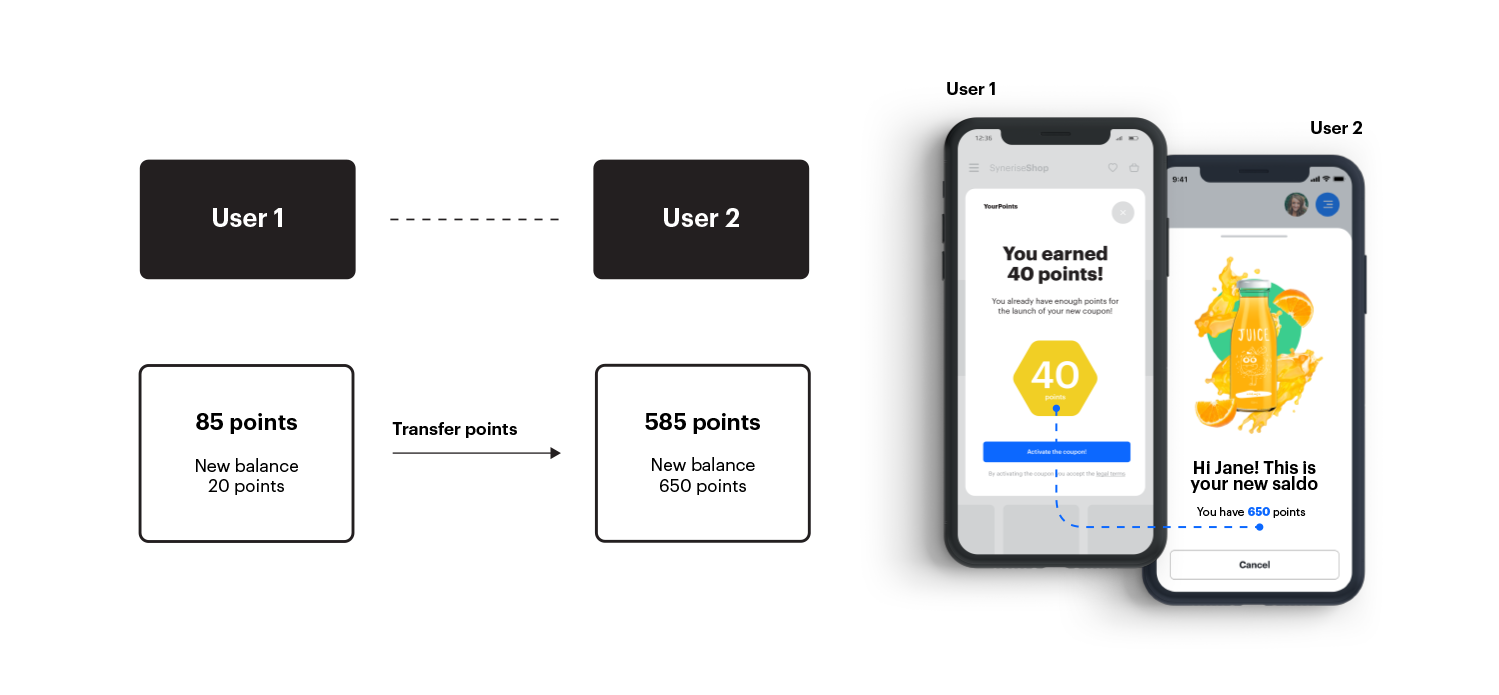
    # STEP 1 Point transfer process --- The transfer of points between users enhances the flexibility and appeal of loyalty programs, fostering a community of engaged and collaborative users. This, in turn, increases customer engagement dynamics and brand loyalty. ## What is the point transfer process? --- Technically, transferring points involves moving them from one user account to another. This is done by removing points from one account and adding them to another, as shown in the attached graphic.
    Diagram illustrating the loyalty points transfer process
    transfer points
    ## Points transferring --- Points transferring between users in Synerise refers to a feature within the Synerise platform that allows users to transfer their accumulated loyalty points to other users. Arrow down icon **DOCUMENTATION**

    In order to inform users that points have been sent from/received to their account, implement fiches in your mobile app to send such messages, e.g. mobile pushes or in-apps. You can find out more about the settings in our documentation for [iOS](/developers/mobile-sdk/configuring-push-notifications/ios) and for [Android](/developers/mobile-sdk/configuring-push-notifications/android). ## Stages of point transfer --- An example of the process of transferring points between users follows several steps: 1. **Configure Loyalty Points in Synerise** - At this stage, we define the segments of eligible senders and receivers of points. 2. **Transfer of loyalty points in the app** - This point relates to setting up the points transfer method directly in any channel. Additional configuration details can be found at the following link. 3. **Create a message template** - This step involves creating a template message that contains details about the point transfer.This notification will be used in an automation and it will inform user that he has received points from another user. 4. **Create a workflow** - Prepare a workflow that will trigger the message when users receive points from another user. The above steps provide a concise guide to using Synerise's points transfer feature. If you are already in the process of implementing points transfer in your loyalty program, make sure you follow each step carefully and consider the specific needs and objectives of your loyalty program. ---
    You already know what is point transfer, in the [**next article**](/loyalty/lesson-3/scenarios) we will show you an example of point transfer.

    # STEP 3 Scenarios In the previous chapter, we discussed the fundamental approaches to expiring accumulated points in loyalty programs. These methods are based on the use of analytics and automation, but their selection should be tailored to the specific requirements and management preferences of your loyalty programme. ## Selected use cases --- Below, you will find the links to two articles providing examples of the practical implementation and detailed configuration of the expiry process for Rolling Cancellation and Regular Batch Cancellation methods. Click the respective links to gain access to in-depth information and specific use cases for each cancellation method.
    Loyalty program use cases overview illustration
    Arrow down icon **BLOG POST**

    In all loyalty programs where points can eventually expire, managing this aspect becomes a significant challenge. We'd like to introduce you to one approach we find effective: the rolling expiration of points, in which expiration date for each loyalty point earning event is set up.

    [**Rolling cancellation**](https://www.synerise.com/blog/manage-the-expiration-of-points-in-your-loyalty-program-with-synerise) | Arrow down icon | Arrow down icon **BLOG POST**

    Every loyalty program based on the earn and burn process can use batch method for expiration points. In our example batch cancellation is set up for 5 million users within 6 hours, followed by communication sent through email.

    [**Batch cancellation**](https://www.synerise.com/blog/loyalty-points-balance-management-with-synerise) | Arrow down icon | ---
    If you are interested in any of the scenarios but don't have an account with Synerise yet, please reach out to us. We will work together to determine the best plan of action! [**Contact Us**](https://www.synerise.com/contact)
    You have just finished lesson 2 - **Congratulations!** Welcome to [**LESSON 3**](/loyalty/lesson-3), where we will dive into the topic of points transfer.

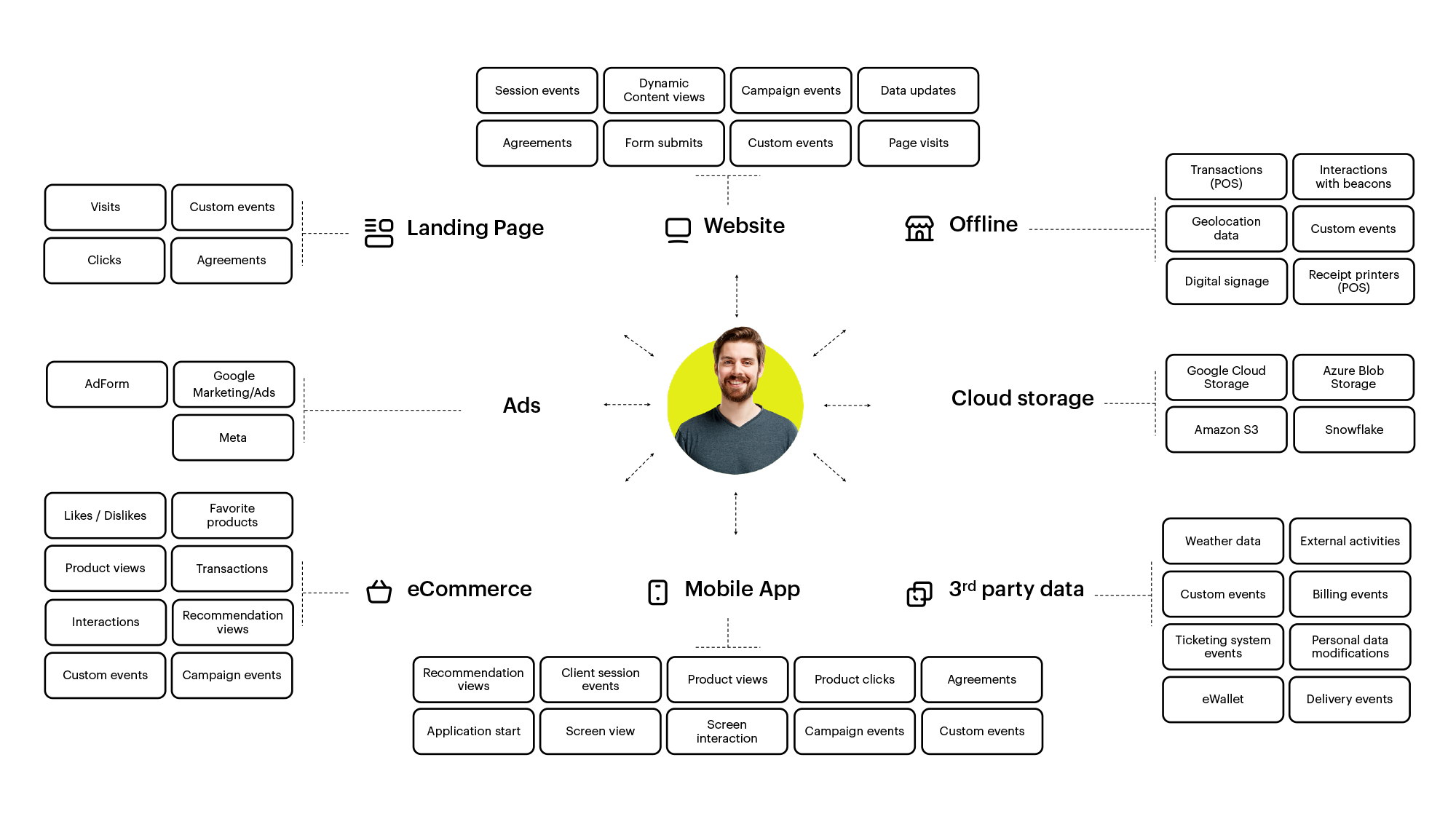
    # STEP 5 Data Exchange Data exchange refers to the process of transferring data between different systems or applications. It ensures that information is shared seamlessly and consistently across platforms, facilitating collaboration and integration. That’s why the foundation of Synerise’s loyalty program is deeply rooted in data utilization. ## Customer centric approach --- The idea of a Synerise-made loyalty program is based on data. Gathering information about the customers and using insights for personalization is a key to success. This is why Synerise offers mobile and JS SDKs as well as API and webhooks to simplify the process of data collection. The overall solution’s architecture looks as follows:
    Loyalty centric approach
    Omnichannel data in customer centric approach
    ### All channels possible --- Integrating multiple channels simultaneously can be tough. That’s why our system is built for flexibility and an agile approach. You can add channels one by one, and the data will be combined into a single customer profile. This lets you guide customers from one touchpoint of contact to the next and communicate with them based on your strategic goals. ### Two-way communication --- Once a channel is integrated with Synerise, we can offer real-time two-way interactions using customer attributes. This shows that we understand the user’s needs, recognize their activities, and build trust through more direct communication.
    If you have gone through all the introductory steps, it is time to start the lesson. Start the [**First lesson**](/loyalty/lesson-1) or go to the [**Main menu**](/loyalty/) to select a lesson according to the feature you are interested in.
    # STEP 2 Creating promotions In the previous chapter, we introduced you to the general process of implementing promotions. In this chapter, you will find information and resources on configuring and managing promotions. ## Promotion management --- The promotion management scope of the Synerise platform includes the entire life cycle of promotions, including creation, editing, publication, hiding, and deletion. The user-friendly interface facilitates efficient management of promotion parameters and allows for dynamic strategy adjustments during campaigns. The platform also supports promotion duplication, enabling the creation of new campaigns based on successful models. Additionally, the ability to create filters within the promotion list allows for easy identification of specific campaigns and facilitates the assignment of promotion sets to customers in personalized campaigns, leading to more targeted audience engagement. Arrow down icon **DOCUMENTATION**

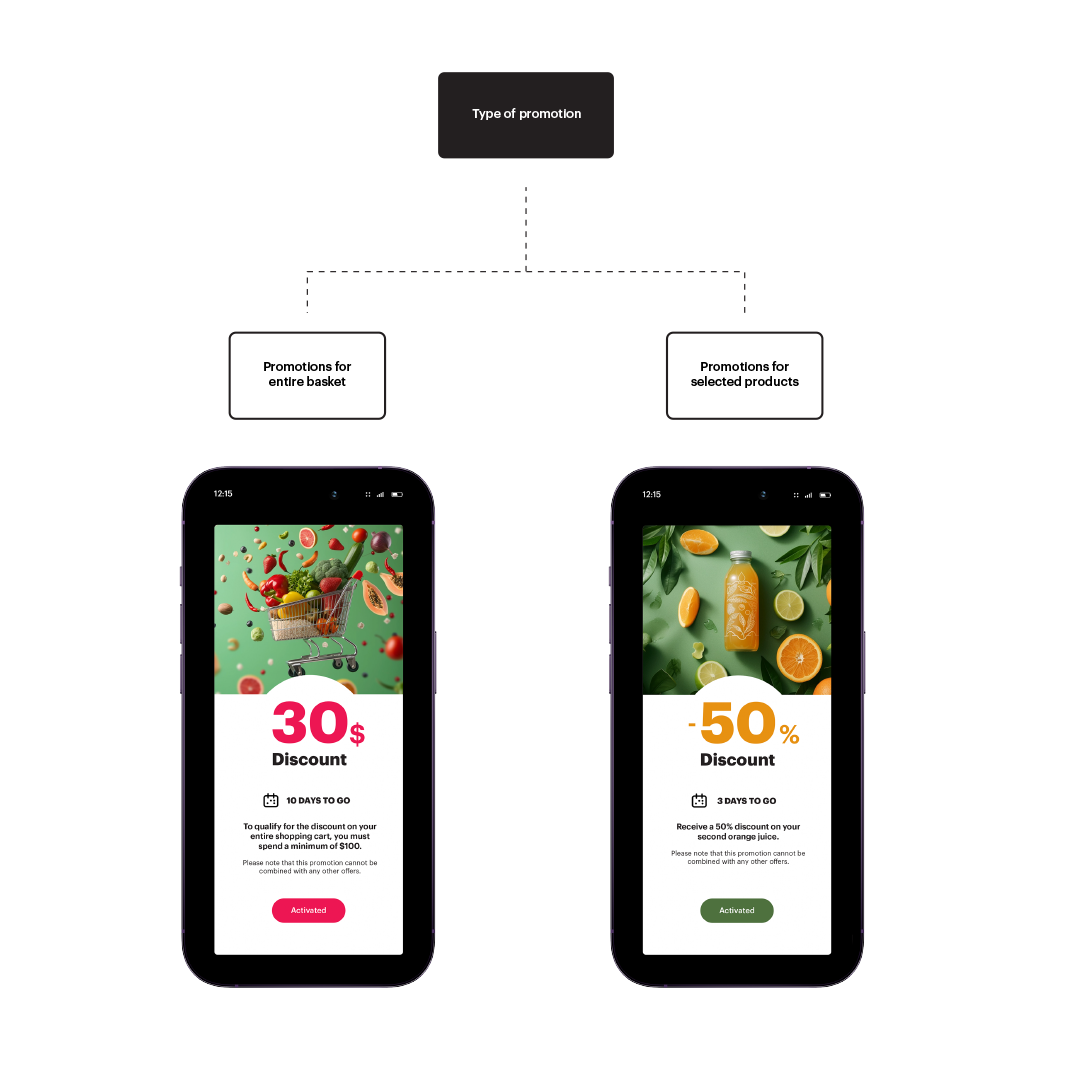
    For more information, see ["Managing promotions"](/docs/ai-hub/promotions/managing-promotions). ## Promotion configuration --- The process of creating promotions begins with selecting its type on the platform. It's time to decide which type of promotion you want to utilize in your loyalty program. Synerise provides you with two operational models: - **Promotions for selected products** - **Promotions for the entire basket**
    Diagram showing the types of promotions in a loyalty program
    Types of promotions
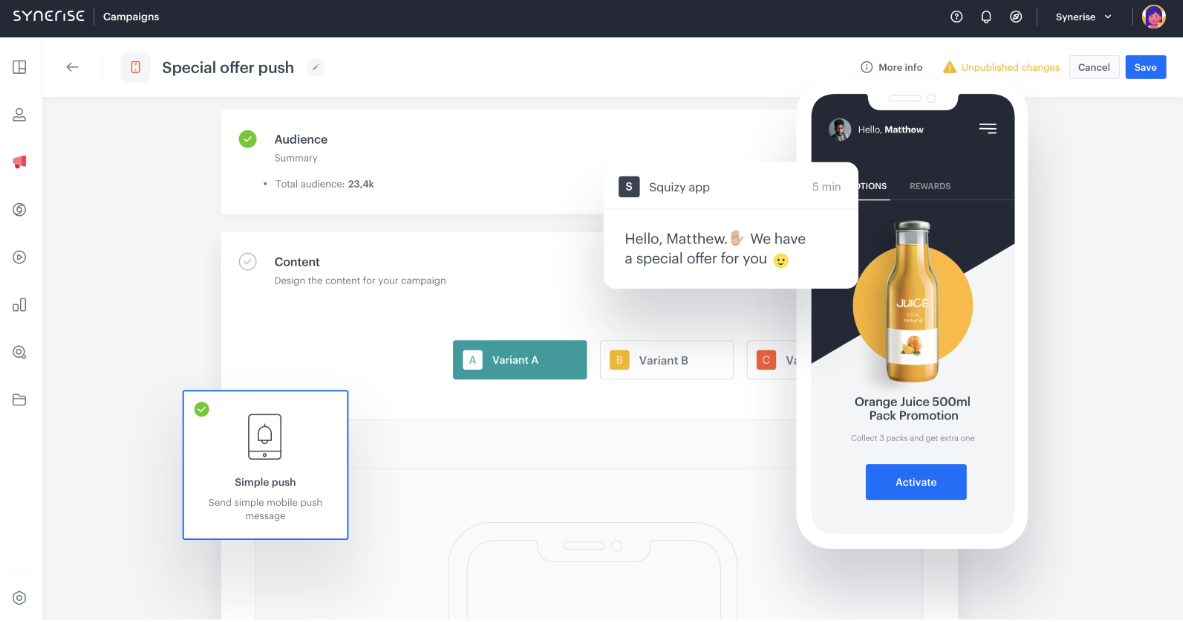
    ### Promotions for selected products Creating promotions for products enables tailoring offers which should promote a specific product or group of products. This may be an effect for instance of cooperation with a vendor (product, brand) or will to sale expiring items (old fashion collection).
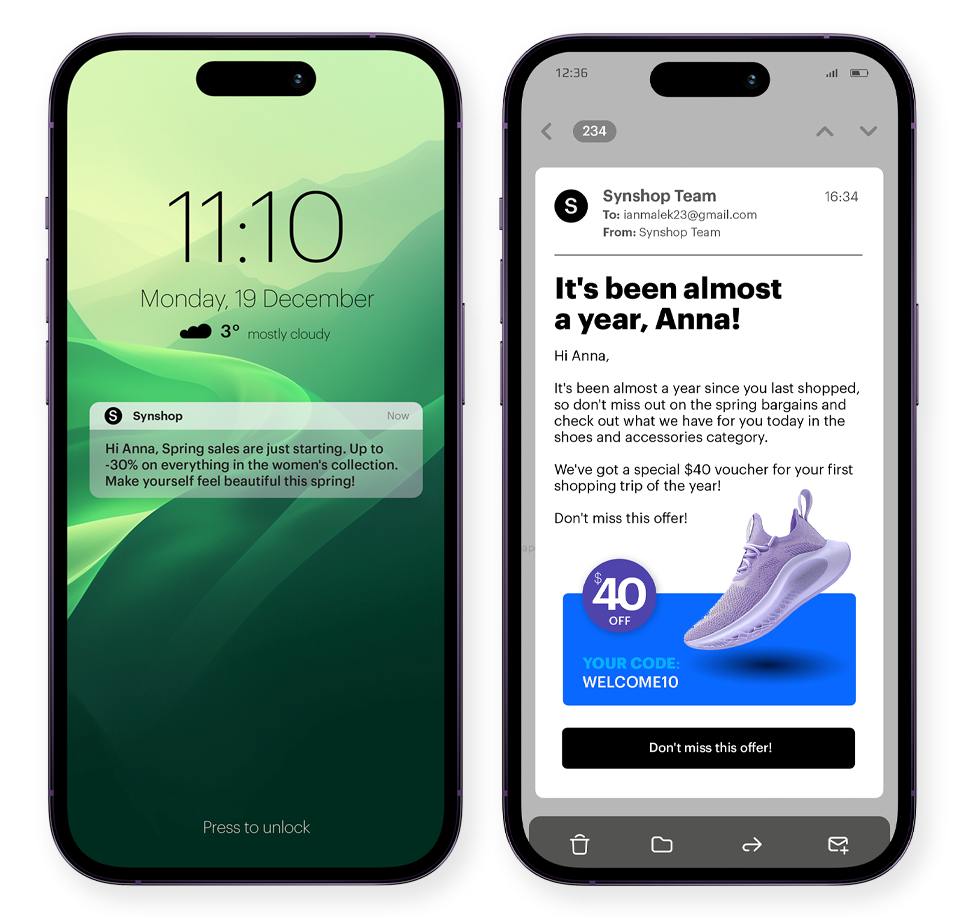
    Promotion distributed through a push notification
    Promotion distributed through a push notification
    Arrow down icon **DOCUMENTATION**

    For more information, see ["Creating promotions for selected products"](/docs/ai-hub/promotions/creating-promotions). ### Promotions for entire basket Promotions in Synerise allow you to prepare personalized, special offers for your customers. A promotion for the entire basket enables the reduction of the entire shopping basket's value if its value meets a set price threshold. This is an effective way to increase the value of the average shopping basket and build customer loyalty by providing them with benefits during shopping. Arrow down icon **DOCUMENTATION**

    For more information, see ["Creating promotions for entire basket"](/docs/ai-hub/promotions/creating-promotions-for-entire-basket). In the subsequent steps of creating a promotion, you will define the types of discounts you want to use, how long the promotion will be available to your recipients, and choose the products or product categories that will be covered by the promotion. ## Promotion import --- To enhance your existing promotional engine with Synerise functionalities, you can seamlessly import promotions without having to create them from scratch. Synerise provides three available methods for importing promotions, ensuring a smooth integration process: - Import creator in Synerise. - Automation in Synerise, - Automation Hub, - Import through API. Arrow down icon **DOCUMENTATION**

    For more information, see ["Importing promotions"](/docs/ai-hub/promotions/importing-promotions). ---
    Now you know how we configure promotions in Synerise, in the [**next article**](/loyalty/lesson-4/scenarios) we explore selected promotion scenarios.

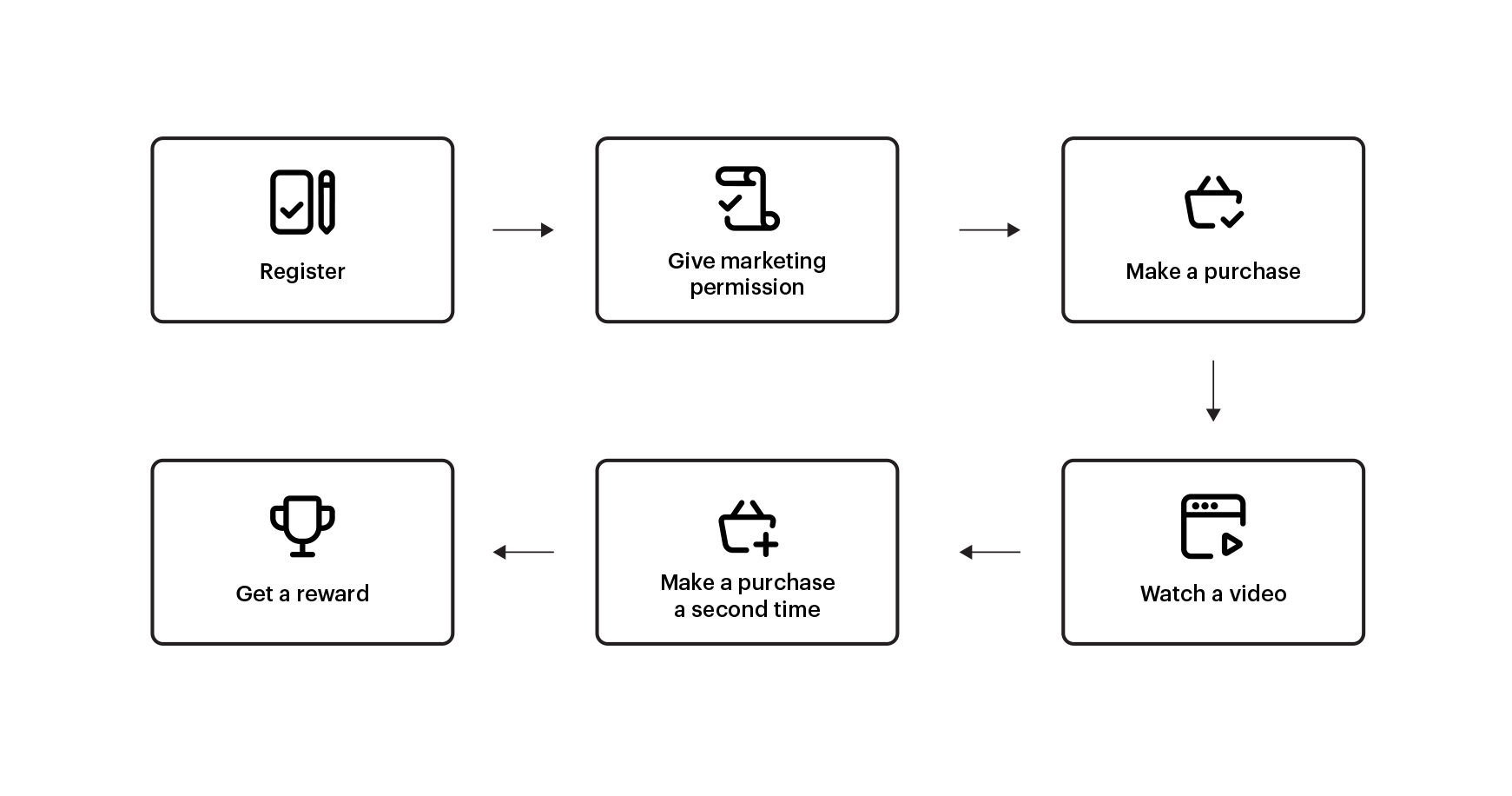
    # STEP 2 Gamification stages In the previous section, we discussed the mechanics of games and the blueprint for creating gamification programs. Now, let's examine the individual steps in their development. | | Gamification scenarios step-by-step: | --- | --- | | **STAGE 1: Define your goals** | **Identify the specific goals** you want to achieve with your loyalty program, such as:
  • Choosing one or more goals will help you design a gamification scenario that aligns with your overall business strategy. | **STAGE 2: Select events and tasks** | Select appropriate [events](/docs/assets/events/event-reference) and tasks on which the loyalty program will be based:

    **1. Events, which contain information about customers**, their activities and purchasing preferences, are the fundamental element upon which gamification scenarios are built. The most popular events considered in gamification programs include: The events chosen should be relevant to the objective of your loyalty program

    **2. Define the rewards** that participants will receive for successfully completing a task. These rewards may include: Make sure the rewards are attractive to your audience and aligned with their interests.
    You can use personalized promotions to select the most suitable reward for a specific player. As a result, your revenue will increase, user engagement will be improved and you'll build lasting customer relationships. | **STAGE 3: Testing:** | **Test gamification elements** with smaller groups before full implementation. Respond to user feedback.