In-app notifications on mandatory application upgrade ensure that your customers are promptly notified and guided through the essential process of updating their mobile application. Enhance user experience, maintain the application's optimal performance, and provide your customers access to the latest features and security improvements. Streamline the upgrade process and keep your customers seamlessly connected with the most up-to-date version of your application through strategic in-app messages.

This use case describes the process of creating an in-app message with information about mandatory application upgrade for customers who have an old version of the application.

This use case provides you with an instruction how to use a ready-made in-app template that can be used 1:1 in a business scenario.

<!-- <figure>
<img src="/api/docs/image/54176ad07f146575310749eba44b7c2f42c1b327/use-cases/all-cases/_gfx/NAZWA-GRAFIKI.png" alt="NAZWA GRAFIKI ROZWINIĘTA W FORMIE PEŁNEGO ZDANIA"  class="full no-frame">
</figure> -->

## Prerequisites 
---
[Implement Synerise SDK in your mobile app](/developers/mobile-sdk).

## Create an in-ap message
---
Create an in-app campaign triggered by the [`client.applicationStarted` event](/docs/assets/events/event-reference/web-and-app#clientapplicationstarted) of the old version of the application. We will use a predefined template for the message with mandatory application upgrade information, so there is no need to create a template from scratch.

1. Go to <img src="/api/docs/image/54176ad07f146575310749eba44b7c2f42c1b327/icons/experience-hub-icon.svg" alt="Experience Hub icon" class="icon" > **Experience Hub > In-app messages> Create in-app**.
2. Enter a meaningful name for the in-app campaign.

### Define the audience
---
As the first step, define the target group of customers for the in-app message.

3. In the **Audience** section:
    1. Click **Define**.
    2. Select the **Everyone** tab.
    3. Click **Apply**.

### Define content
---
1. In the **Content** section, click **Define**.:
    1. Click **Create message**.
    2. Go to the **Predefined templates** folder and choose **Fullscreen** template.
 

   <div class="admonition admonition-note"><div class="admonition-icon"><svg xmlns="http://www.w3.org/2000/svg" fill="none" viewBox="0 0 24 24" stroke="currentColor" stroke-width="2.5"><path stroke-linecap="round" stroke-linejoin="round" d="M13 16h-1v-4h-1m1-4h.01M21 12a9 9 0 11-18 0 9 9 0 0118 0z" /></svg></div><div class="admonition-body"><div class="admonition-content">

   You can edit the template in two ways, by editing the code of the template ([add inserts](/docs/campaign/in-app-messages/creating-inapp-templates/creating-inapp-template#adding-a-snippet-to-the-template-code), [add variables](/docs/campaign/in-app-messages/creating-inapp-templates/creating-inapp-template#adding-a-variable)) and/or by filling out the form in the **Config** tab. In this use case, we will use the capabilities of the predefined **Config** tab.

   </div></div></div>


#### Edit form in the Config tab
---
The form in the **Config** tab is already filled in with default values. You can keep them or change them to fit your business needs.  
 
1. In the **Background** section, use the color picker to select the color of the background or enable background image and enter the link to this image (add the image to **Data Modeling Hub > Files** and then you can find there the URL to this image).
2. In the **Image** section, enable the image in your banner campaign and add the link to this image (add the image to **Data Modeling Hub > Files** and then you can find there the URL to this image). 
3. In the **Header** section, enable header and add the text, font size and color of the header you want to display in the in-app message.
4. In the **Description** section, enable description and add the text, font size and color of the description you want to display in the in-app message.
5. In the **CTA button** section, enable the CTA and add the text on the button, corner radius of the button, text color, button background color, and URL to which you want to redirect a mobile app user.
6. In the **Close button** section, disable this option. Thanks to this, the in app message cannot be closed, and the user must click the CTA button.
7. After you make changes to the template, you can check the preview.
    1. Click the **Preview** button on the upper left side.
    2. Enter the ID of a mobile app user.
    3. Click **Apply**.
8. To continue the process of configuring the in-app campaign, click **Next**.
9. To save your content changes, click **Apply**.

### Select events that trigger the in-app message display
---
In this part of the process, you will define the event triggering the display of the in-app message.

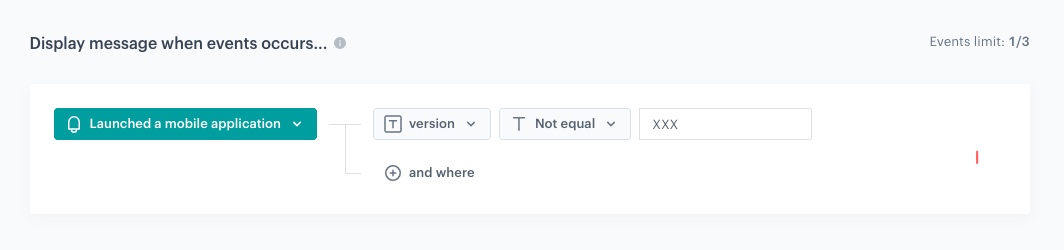
1. In the **Trigger events** section, click **Define**.
2. Select **Add event** and from the dropdown list, choose `client.applicationStarted` event.

   <div class="admonition admonition-note"><div class="admonition-icon"><svg xmlns="http://www.w3.org/2000/svg" fill="none" viewBox="0 0 24 24" stroke="currentColor" stroke-width="2.5"><path stroke-linecap="round" stroke-linejoin="round" d="M13 16h-1v-4h-1m1-4h.01M21 12a9 9 0 11-18 0 9 9 0 0118 0z" /></svg></div><div class="admonition-body"><div class="admonition-content">

   Event `client.applicationStarted` is retained (can be seen on the activity list in the customer profile), and it only generates when the application was closed, and then opened again.

   </div></div></div>

3. Click the **+ where** button and select `version`.
4. As the logical operator, select **Not equal**.
5. In the text field, type the latest app version.
5. Click **Apply**.

<figure>
<img src="/api/docs/image/54176ad07f146575310749eba44b7c2f42c1b327/use-cases/all-cases/_gfx/mandatory_trigg.png" alt="The view of the in-app trigger event configuration" class="full">
<figcaption> In-app trigger event configuration </figcaption>
</figure>

### Schedule the message and configure display settings
---
As the final part of the process, you will set the display settings of the in-app message such as schedule, capping, priority of the message among other in-app messages.

1. In the **Schedule** section, click **Define** and set the time when the message will be active. 
2. In the **Display Settings** section, click **Change**.
3. Define the **Delay display**, **Priority index** according to your business needs.
4. Enable the **Capping limit** toggle to limit the amount of times the in-app message can be displayed to a user in general, set it to **1**.
5. Click **Apply**. 
6. Optionally, you can define the **UTM parameters** and [**Additional parameters**](/docs/campaign/in-app-messages/create-inapp-message#adding-custom-parameters) for your in-app campaign.
7. Click **Activate**.

## Check the use case set up on the Synerise Demo workspace
---
You can check the [In-app message](https://app.synerise.com/communications/in-app/de9da8a0-8478-4d80-a15d-a35703958243) configuration directly in Synerise Demo workspace. 

If you’re our partner or client, you already have automatic access to the **Synerise Demo workspace (1590)**, where you can explore all the configured elements of this use case and copy them to your workspace.  

If you’re not a partner or client yet, we encourage you to fill out the contact [form](https://demo.synerise.com/request) to schedule a meeting with our representatives. They’ll be happy to show you how our demo works and discuss how you can apply this use case in your business. 

## Read more
---
- [In-app messages](/docs/campaign/in-app-messages)
- [Using in-app template builder](/docs/campaign/in-app-messages/creating-inapp-templates/creating-inapp-template)