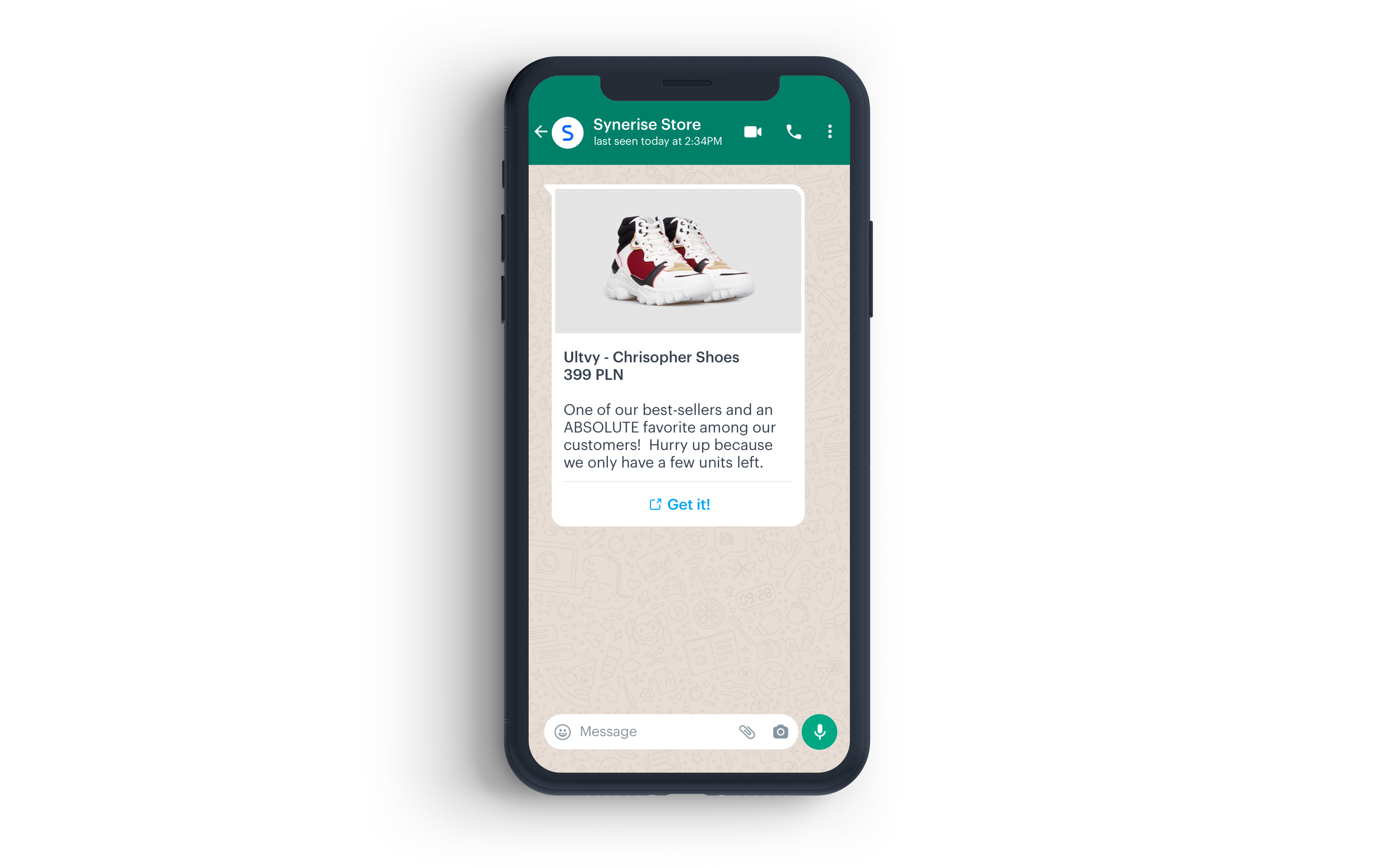
You can use WhatsApp to send personalized messages to potential customers who have viewed a product page and have high propenisty to buy, motivating them even more to return and purchase popular or beststelling products. Increase customer engagement and drive sales with communication that ensures customers receive customized and relevant messages with enticing incentives and exclusive deals.

In this use case, you will create a workflow that sends a message on WhatsApp with the bestselling products. This workflow will be triggered by a visit to a page, however, the message will be sent only to customers with a high propensity to buy and who visited the product page and haven't made a purchase just to encourage them to come back and make a purchase.

<figure>
<img src="/api/docs/image/54176ad07f146575310749eba44b7c2f42c1b327/use-cases/all-cases/_gfx/promo_mes.png" alt="Whatsapp bestseller message"  class="full no-frame">
</figure>

## Prerequisites 
---
- Make sure you meet [all prerequisites](/docs/automation/integration/whats-app/send-template-message#prerequisites) to work with the **Send Template Message** node.
- Implement a [tracking code](/developers/web/installation-and-configuration) into your website.
- Implement the [transaction events](/developers/web/transactions-sdk) using [SDK](/developers/web/transactions-sdk) or [API](https://developers.synerise.com/DataManagement/DataManagement.html#operation/CreateATransaction).
- [Configure an item catalog for recommendations](/docs/settings/configuration/ai-engine-configuration/engine-configuration-for-recommendations). Select the **Top items** model to train the feed.  
- Create a recommendation desribed in [this use case](/use-cases/recommendations-bestsellers#prepare-ai-recommendation).
- Create a Propensity prediction described in [this use case](/use-cases/propensity-brand).

## Process
---

In this use case, you will go through the following steps:
1. [Create a message template in the Meta portal](#create-a-message-template-in-the-meta-portal)
3. [Create a workflow to send message to customers on WhatsApp](#create-a-workflow-to-send-message-to-customers-on-whatsapp)


## Create a message template in the Meta portal 
---
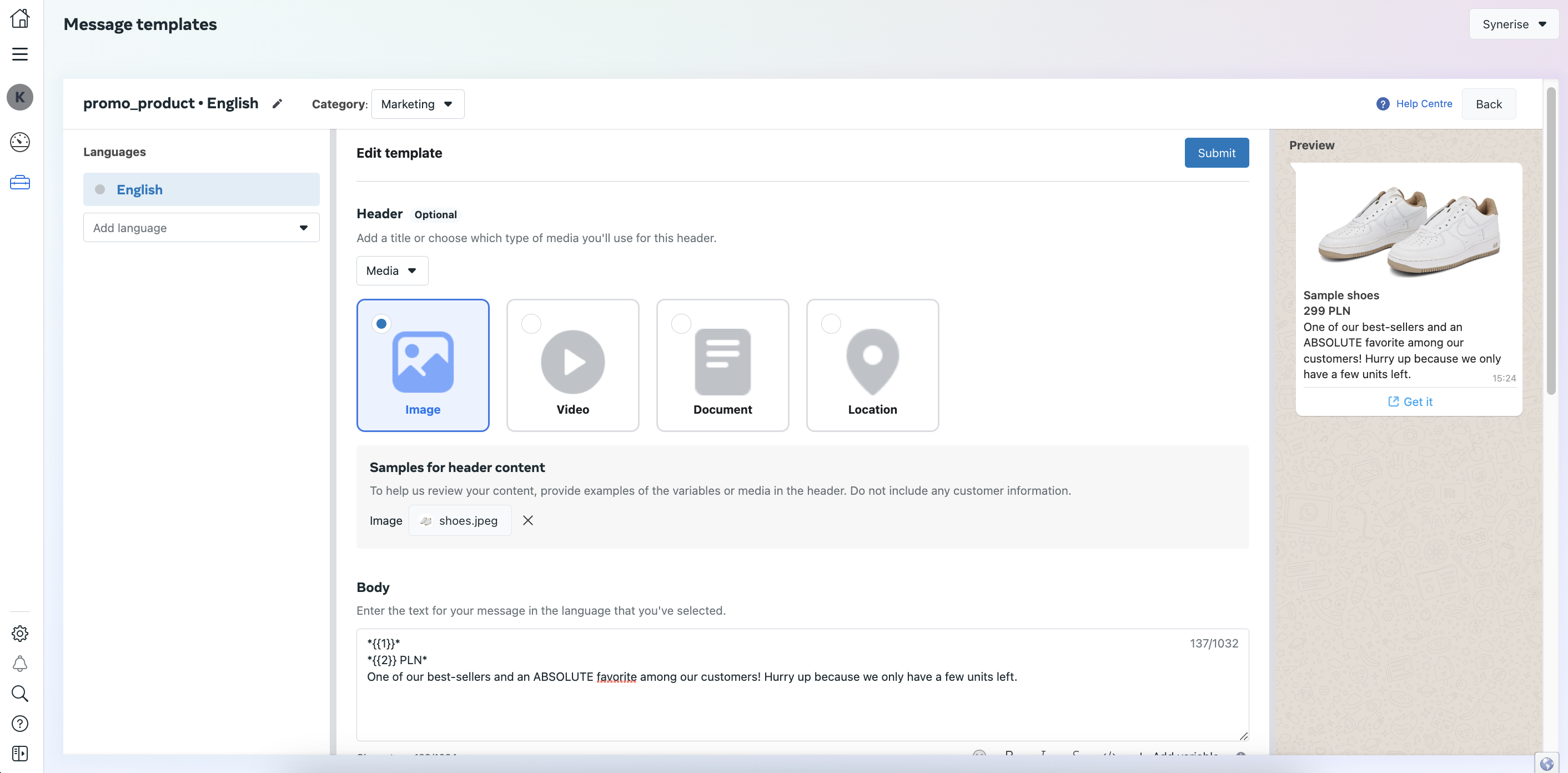
Create a message template in the Meta portal that you will use in the next part of the process. In the body of the message, mark places where the dynamic elements will be added.

The example message used in this use case:
`*{{1}}* *{{2}} PLN* One of our best-sellers and an ABSOLUTE favorite among our customers! Hurry up because we only have a few units left.`

Where `{{1}}` and `{{2}}` are markers that will be replaced with the dynamic values. This step will be done in Synerise.

The screen below shows an example of template message creation in the Meta portal:

<figure>
<img src="/api/docs/image/54176ad07f146575310749eba44b7c2f42c1b327/use-cases/all-cases/_gfx/promo_meta.png" alt="An example of body section configuration in the Meta platform"  class="large">
<figcaption>An example of body section configuration in the Meta platform</figcaption>
</figure> 

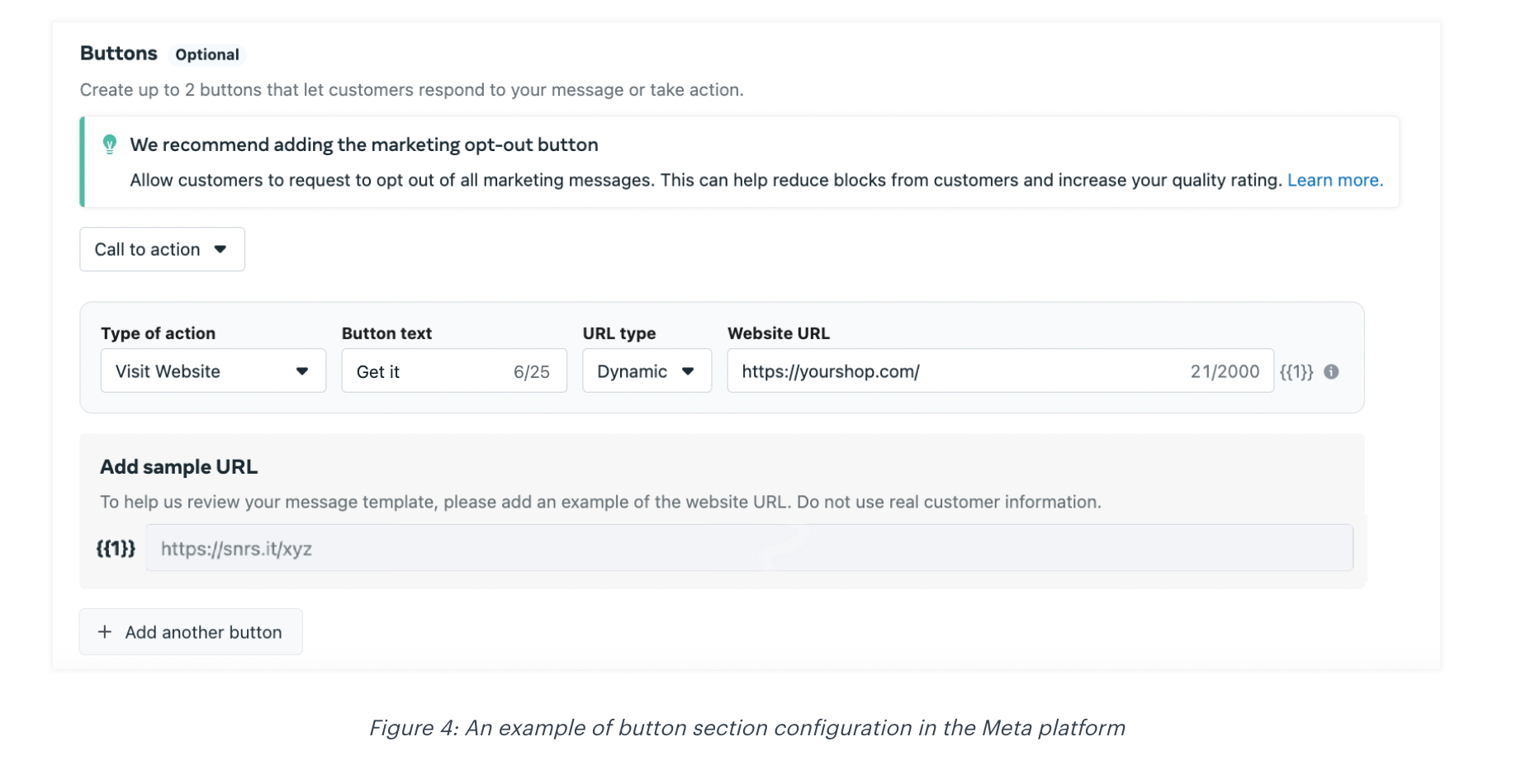
In the following screen, you can see how a button can be defined in the Meta portal:

<figure>
<img src="/api/docs/image/54176ad07f146575310749eba44b7c2f42c1b327/use-cases/all-cases/_gfx/promo_button.png" alt="An example of button section configuration in the Meta platform"  class="large">
<figcaption>An example of button section configuration in the Meta platform</figcaption>
</figure> 

## Create a workflow to send message to customers on WhatsApp
---
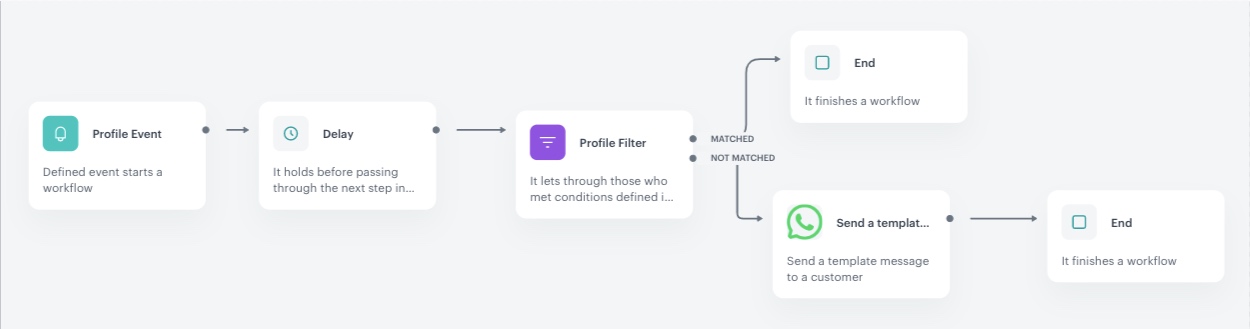
The workflow will be triggered by the `Visited page` event for customers with high propenisty to buy. The delay is defined up to 1 day. If a customer does not make a transaction within one day, we will send a WhatsApp message encouraging customers to come back and buy a bestselling product.

1. Go to <img src="/api/docs/image/54176ad07f146575310749eba44b7c2f42c1b327/icons/automation-hub-icon.svg" alt="Automation Hub icon" class="icon" > **Automation Hub > Workflows > New workflow**.  
2. Enter the name of the workflow.

### Define the trigger node
---
1. As the first node, add the **Profile Event**. In the settings of the node, select the **Visited page** event.
2. Click **Apply**.

### Configure the Delay node
---
1. Add the **Delay** node. In the node settings:
    1. In the **Delay** field, type `1`.
    2. From the dropdown list, choose **Day**.
2. Click **Apply**.

### Define the Profile Filter node
---
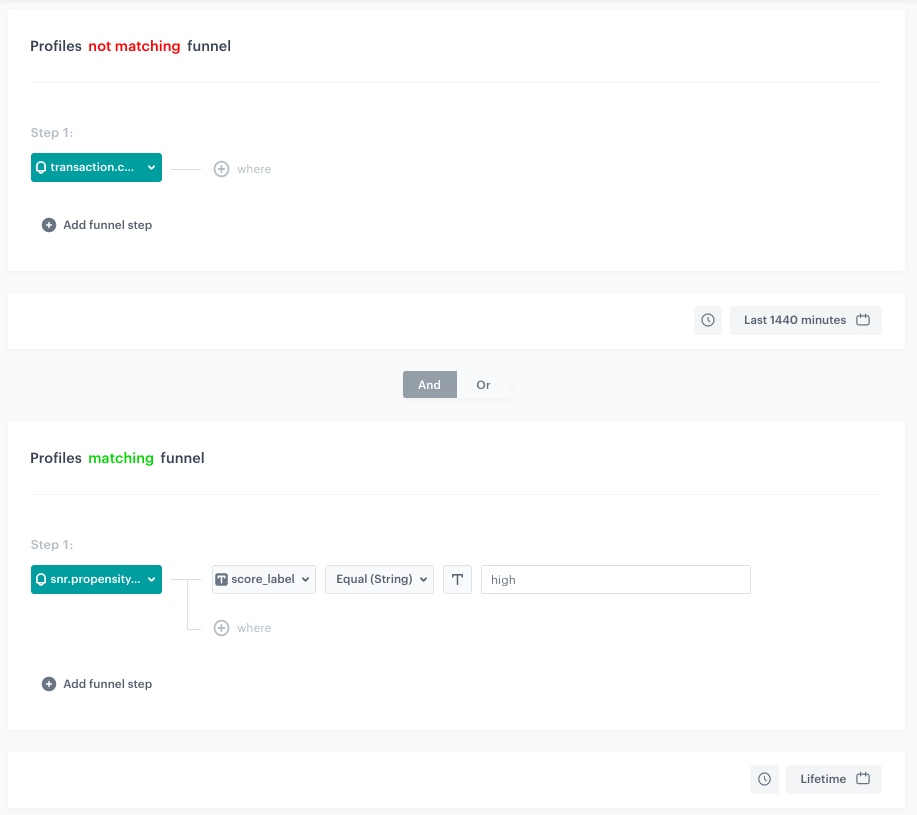
As the next node, choose **Profile Filter** to check if a customer with high propenisty to buy have made a transaction in the last 24 hours.

1. Add the **Profile Filter** node. In the node settings:
    1. From the **Choose filter** dropdown, select the `transaction.charge` event.
    2. Change **matching** to **not matching**.
    3. Set the date range to the last 1440 minutes.     
    
       <div class="admonition admonition-important"><div class="admonition-icon"><svg xmlns="http://www.w3.org/2000/svg" fill="none" viewBox="0 0 24 24" stroke="currentColor" stroke-width="2.5"><path stroke-linecap="round" stroke-linejoin="round" d="M12 8v4m0 4h.01M21 12a9 9 0 11-18 0 9 9 0 0118 0z" /></svg></div><div class="admonition-body"><div class="admonition-content">

       Use 1440 minutes instead of 1 day – use smaller granulation, as in this case 1 day would take the time from current hour till the midnight, so such an analysis will not take into consideration all necessary users.

       </div></div></div>

    4. From the **Choose filter** dropdown, select the `snr.propenisty.score` event.
    5. Click **+ where**. 
    6. As the event parameter, select `score_label`.
    7. As the logical operator, select **Equal**.
    8. In the text field, enter `high`.
    9. As the date range, select **Lifetime**.
2.  Click **Apply**.

<figure>
<img src="/api/docs/image/54176ad07f146575310749eba44b7c2f42c1b327/use-cases/all-cases/_gfx/whatsapp_bestseller.png" alt="The view of Profile Filter node configuration"  class="large">
<figcaption>Configuration of the Profile Filter node</figcaption>
</figure>

### Define the Send a template mesage node 
---
1. To the **Not matched** path, add the WhatsApp **Send Template Message** node.
2. Click **Select connection**.
3. From the dropdown list, select the connection.
    - If no connections are available or you want to create a new one, see [Create a connection](/docs/automation/integration/whats-app/send-template-message#create-a-connection).
    - If you selected an existing connection, proceed to defining the integration settings.
4. In the **Sender ID** field, enter the phone number ID from which the message will be sent.
[You can find more information about phone number ID here](https://developers.facebook.com/docs/whatsapp/cloud-api/get-started/add-a-phone-number).
5. In the **Receiver** field, enter the phone number of the customer who will receive this message.
We recommend using the `{% customer phone %}` insert, which inserts the phone number of an individual customer who goes through this node.
6. In the **Message template** field, enter the name of the [message template](#create-a-message-template-in-the-meta-portal) you created earlier in the Meta portal.
7. From the **Language code** dropdown list, select the language used in the message.
8. In the **Message components** field, insert the object that contains the dynamic values in the order defined in the message template.  
   The example of object used in this use case:
    
   <div class="admonition admonition-note"><div class="admonition-icon"><svg xmlns="http://www.w3.org/2000/svg" fill="none" viewBox="0 0 24 24" stroke="currentColor" stroke-width="2.5"><path stroke-linecap="round" stroke-linejoin="round" d="M13 16h-1v-4h-1m1-4h.01M21 12a9 9 0 11-18 0 9 9 0 0118 0z" /></svg></div><div class="admonition-body"><div class="admonition-content">

   The recommendation ID is used as examples for the purpose of this use case.

   </div></div></div>

        
   <pre><code class="language-json">[
            {
                    "type": "body",
                    "parameters": [ 
                        {
                            "type": "text",
                            "text": "{% set products = [] %}{% recommendations3 campaignId=VrEXZm00A7CK %}{% for p in recommended_products3 %}{% do products.append(p) %}{% endfor %}{% endrecommendations3 %}{{ products[0].title }}" 
                        }, 
                        { 
                            "type": "text", "text": "{{ products[0].price }}" 
                        } 
                    ] 
                },
                { 
                    "type": "button", 
                    "index": "0",
                    "sub_type": "url",
                    "parameters": [ 
                        { 
                            "type": "url",
                            "text": "{{ products[0].title|replace('https://yourshop.com', '') }}" 
                        } 
                    ] 
                }, 
                { 
                    "type": "header", 
                    "parameters": [ 
                        { 
                            "type": "image", 
                            "image": { 
                                "link": "{{ products[0].image_link }}" 
                            } 
                        } 
                    ] 
                } 
            ]</code></pre>
 

9. Click **Apply**.

The following table explains all the inserts used in the body, button and header sections shown above.

| Section  | Insert value                                                                                                                                                                                        | Insert explanation                                                                                                                                                                                                                                                   |
|--------- |---------------------------------------------------------------------------------------------------------------------------------------------------------------------------------------------------- |--------------------------------------------------------------------------------------------------------------------------------------------------------------------------------------------------------------------------------------------------------------------- |
| body     | `{% set products = [] %}{% recommendations3 campaignId=VrEXZm00A7CK %}{% for p in recommended_products3 %}{% do products.append(p) %}{% endfor %}{% endrecommendations3 %}{{ products[0].title }}`  | The value of this insert is used as the value of `{{1}}`, so the name of recommended product can be displayed in the message.                                                                                                                                        |
| body     | `{{ products[0].price }}`                                                                                                                                                                           | The value of this insert is used as the value of `{{2}} PLN`, to show the price of the item.                                                                                                                                                                         |
| button   | `{{ products[0].title\|replace('https://yourshop.com', '') }}`                                                                                                                                      | The value of this insert is used to return product url. Here we specify the URL omitting the domain, because we define the domain in the Meta platform, as you can see in the screenshot with the [button creation](#create-a-message-template-in-the-meta-portal).  |
| header   | `{{ products[0].image_link }}`                                                                                                                                                                      | The value of this insert is used to return the product image in the header.                                                                                                                                                                                          |

### Add the finishing node 
---
1. Add the **End** node to the **Send Template Message** node.
2. To the **Matched** path, add the **End** node.
3. In the upper right corner, click **Save & Run**.

<figure>
<img src="/api/docs/image/54176ad07f146575310749eba44b7c2f42c1b327/use-cases/all-cases/_gfx/whatsapp_bestseller_workflow.png" alt="The view of Workflow configuration"  class="full">
<figcaption>Configuration of the Workflow</figcaption>
</figure>

## Check the use case set up on the Synerise Demo workspace
---
You can check the [recommendation](https://app.synerise.com/ai-v2/recommendations/4KW2iNyhE5nY) and [workflow](https://app.synerise.com/automations/automation-diagram/a958fb74-1280-4176-9041-22a8f43b463a) configuration directly in Synerise Demo workspace. 

If you’re our partner or client, you already have automatic access to the **Synerise Demo workspace (1590)**, where you can explore all the configured elements of this use case and copy them to your workspace.  

If you’re not a partner or client yet, we encourage you to fill out the contact [form](https://demo.synerise.com/request) to schedule a meeting with our representatives. They’ll be happy to show you how our demo works and discuss how you can apply this use case in your business. 

## Read more
---

- [Automation Hub](/docs/automation)
- [Jinjava inserts](/developers/inserts)
- [Predictions](/docs/ai-hub/predictions)
- [Recommendations](/docs/ai-hub/recommendations-v2)
- [WhatsApp Send Template Message node](/docs/automation/integration/whats-app/send-template-message)