In this section in the Behavioral Data Hub, you can define the attributes you can assign to a customer. These attributes are pieces of information that describe a customer, for example, first name and last name, date of birth, nationality. Attributes are assigned to users:
IMPORTANT: The list doesn't cover all cases, but the most common ones.
- When a visitor to the website submits a form
- When you import your customers to Synerise
- When you edit a customer's profile in Behavioral Data Hub > Profiles
- When you launch a workflow which updates customer's attributes in response to a specific trigger.
- When you share and synchronize segmentation results (only membership attributes)
Useful references
- API: Add or update profiles method
- Use cases: Coupon for membership anniversary or birthday (birthdate attribute used)
Use of profile attributes
Profile attributes are used widely in the Decision Hub.
- They are frequently used while building audiences. You can group customers into segments according to age, gender, tags assigned to them, area where they reside, and so on.
- Attributes come in handy in other types of analyses too. You can use them to narrow down the results of the analyses, for example, you can narrow down the results of a metric that counts the number of visits to the website by users with the email address within
example.com. - You can create a report where data can be organized by any attribute such as gender, date of birth, tags, last activity date, and so on.
They are used in Automation Hub as well.
- A workflow can be triggered by the update of customer attributes or end up updating the attributes.
- You can trigger a workflow for the audience which you can define by using customer attributes. This way for example, you can run the workflow for customers with a particular tag assigned.
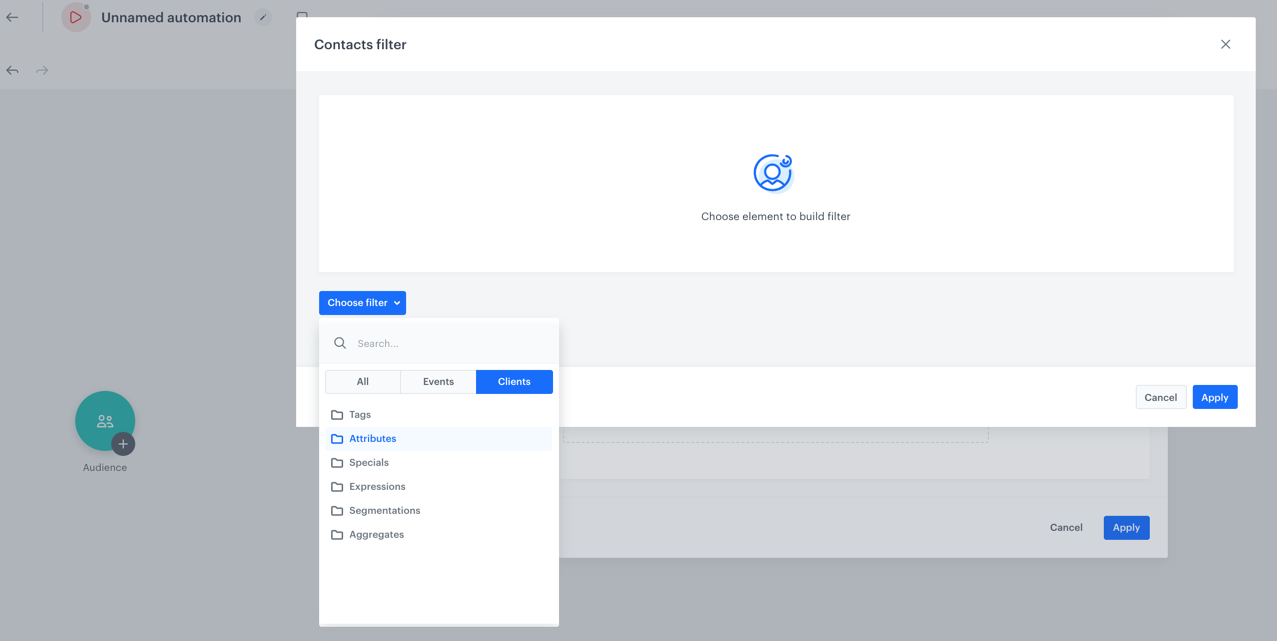
- You can narrow down the participants in the further parts of the workflow by using the Profile Filter node. The settings of the node, similarly to the Audience node, let you filter out customers by using the attributes.
Apart from the usage in Decision Hub and Automation Hub, you can use attributes to filter out customers on the list in Behavioral Data Hub.
Types of profile attributes
Default - These are the standard attributes which are filled in when a new customer is added or updated when a customer submits a form on a website again, when you import customers to Synerise or manually modify data in the customer's profile. Also, when you create or update a customer's profile, you can leave the attributes empty.
Click to see the list of default attributes
- phone
- customId
- firstName
- lastName
- uuid
- avatarUrl
- birthDate
- company
- city
- address
- zipCode
- province
- countryCode
- sex
- agreements
- attributes
- tags
TIP: You can find more info how to send these attributes and their values through API here. Pay attention to the correct format of the attributes.
- Custom - These are the attributes which you add on your own either by using API or you can add them manually on the interface.
TIP: When you update/create a profile over the API with an attribute that does not exist, a definition of that attribute is created automatically.
- Membership attributes - An attribute which is created as a result of sharing and synchronizing segmentation results. These attributes have a boolean value (true or false) indicating whether a profile belongs to a segmentation from the current workspace or other workspaces (if you use co-brand workspaces).
- Other - Technically, they are custom attributes updated by various backend services in Synerise, such as the attribute that informs about the marketing agreement status update or longitude/latitude.
Viewing profile attributes
- You can find a complete list of attributes you can assign to profiles in
 Behavioral Data Hub > Attributes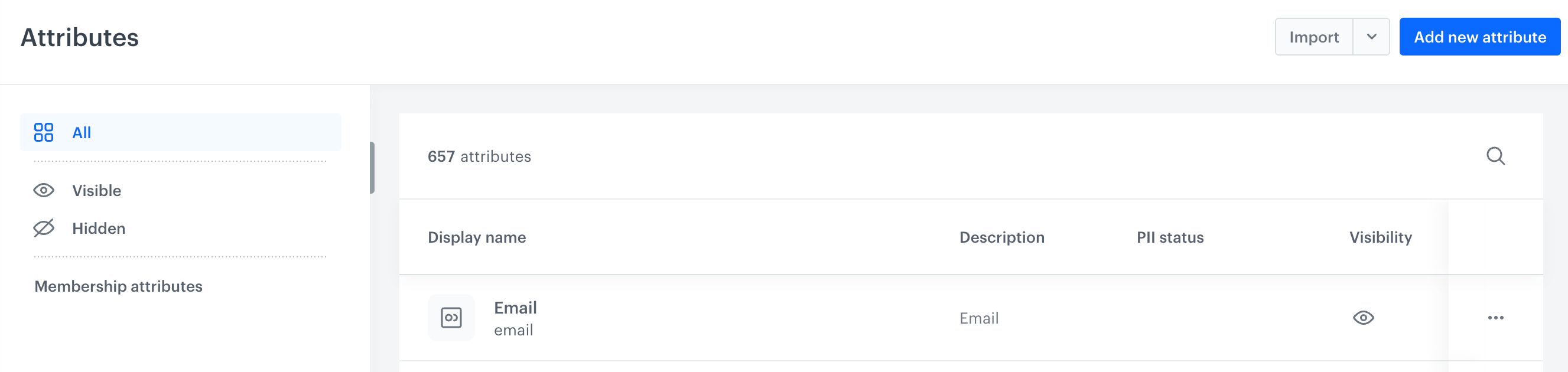
The list of customer properties - To check the attributes of a particular profile, go to Behavioral Data Hub > Profiles. The attributes of the profile are visible on the left side.
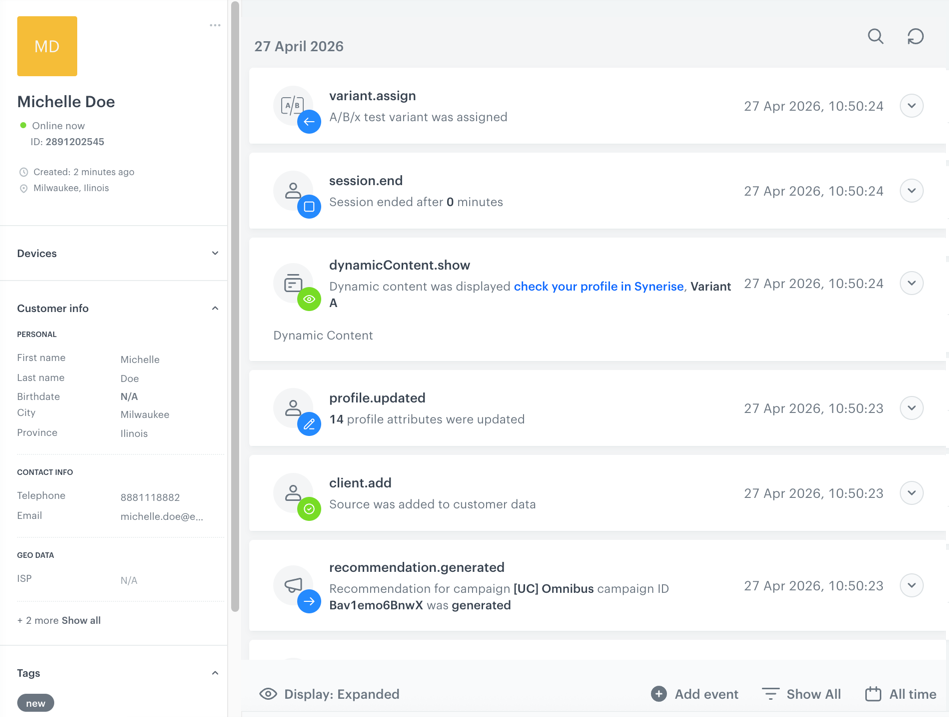
A profile of an example customer
Adding profile attributes in the Synerise portal
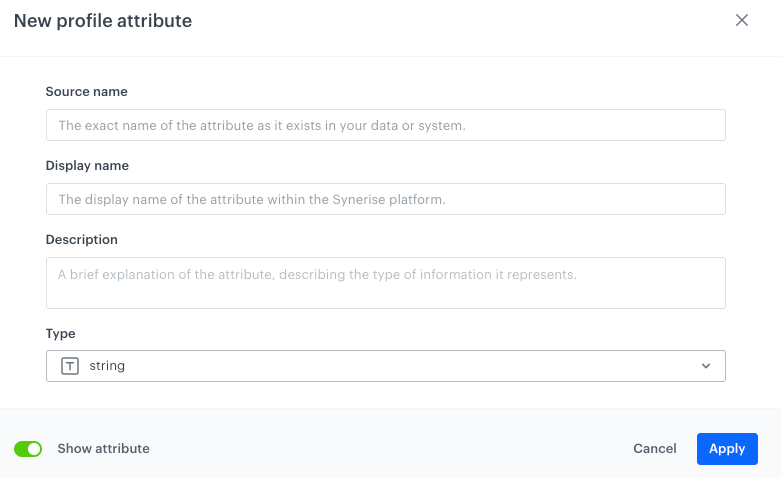
- Go to Behavioral Data Hub > Attributes > Add new attribute.
- In the Source name field, enter the name of the parameter as it is sent by the SDKs/API.
- In the Display name field, enter a human-readable label for display in the Synerise portal.
- Optionally, in the Description field, you can add an explanation about the purpose of this property.
- From the Type dropdown list, select the format of the property value as sent by the SDKs/API.
- If you don't want to display this attribute in the filters across the Synerise platform, disable Show attribute.
- Confirm by clicking Save.
Managing membership attributes
Membership attributes are created when the segmentation sharing process is initiated. The segmentation results are saved as membership attributes and are synchronized.
These attributes have a boolean value (true or false) indicating whether a profile belongs to a segmentation from the current workspace or other workspaces (if you use Co-Brand Decisioning Layer).
The membership attributes will have predefined names, format:
- display name:
<workspace name>: mbr <segmentation name>, however, you can change its display name - source name:
<workspace name>:_mbr_<segmentation_id>
Where:
<workspace name>is the name of your workspace<segmentation name>is the name of the segmentation<segmentation_id>is the ID of the segmentation
When sharing segmentation results:
- within a single workspace, you can track how profiles join or leave segmentations, helping you analyze the impact of your activities on profiles.
- across a workspace group, you can identify profiles that exist in your other workspaces and build audiences combining those profiles. This lets you optimize costs by avoiding sending duplicate campaigns.
Restrictions
- The value of membership attributes cannot be changed manually; it is updated only through synchronization (launched on the user's interface only).
- The attribute source name cannot be changed.
- Membership attributes are not included when importing profiles.
Viewing attribute details
The scope of information available in the details of the membership attribute:
- source segmentation - you can get the ID and the link to the segmentation whose result is in the attribute. The possible values are:
true- a profile belongs to the segmentation;false- a profile left segmentation;- no attribute related to a given segmentation - the profile has never belonged to the segmentation.
- the name of the workspace the source segmentation comes from
- link and the ID to the process that updates the value of the membership attribute
- the date of latest update of the attribute value
- the same information as in sharing segmentatation to a single workspace
- the source name of the membership attribute
- display name of the membership attribute
- description
- status of attribute visibility across filters in the Synerise platform in a given workspace
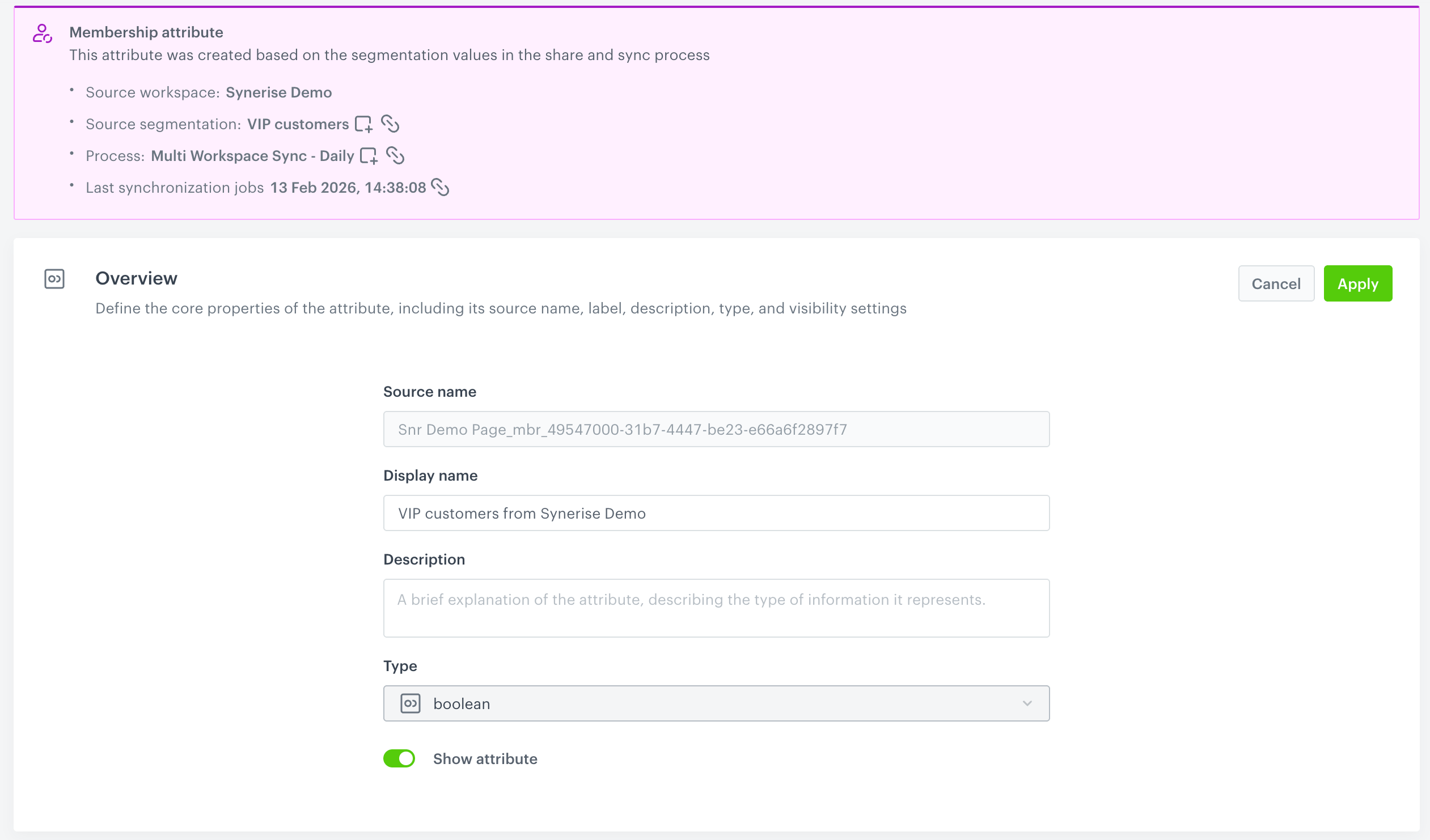
- Go to Behavioral Data Hub > Attributes.
- On the left panel, select Membership attributes.
Changing display name and description
- In Display name, you can provide a user-friendly name of the membership attribute.
This name will display in the filters in the Synerise platform. - In Description, you can provide a description for the membership attribute that explains the purpose of it to other workspace users.
Changing membership attribute visibility
To display or hide this attribute in the filters in the Synerise platform, use the Show attribute toggle.