In this section of the index settings, you can:
- select the language of the search engine.
- define how words are separated.
- select the logical operator among multiple query rules which contain Elastic and Static Filter in their consequences.
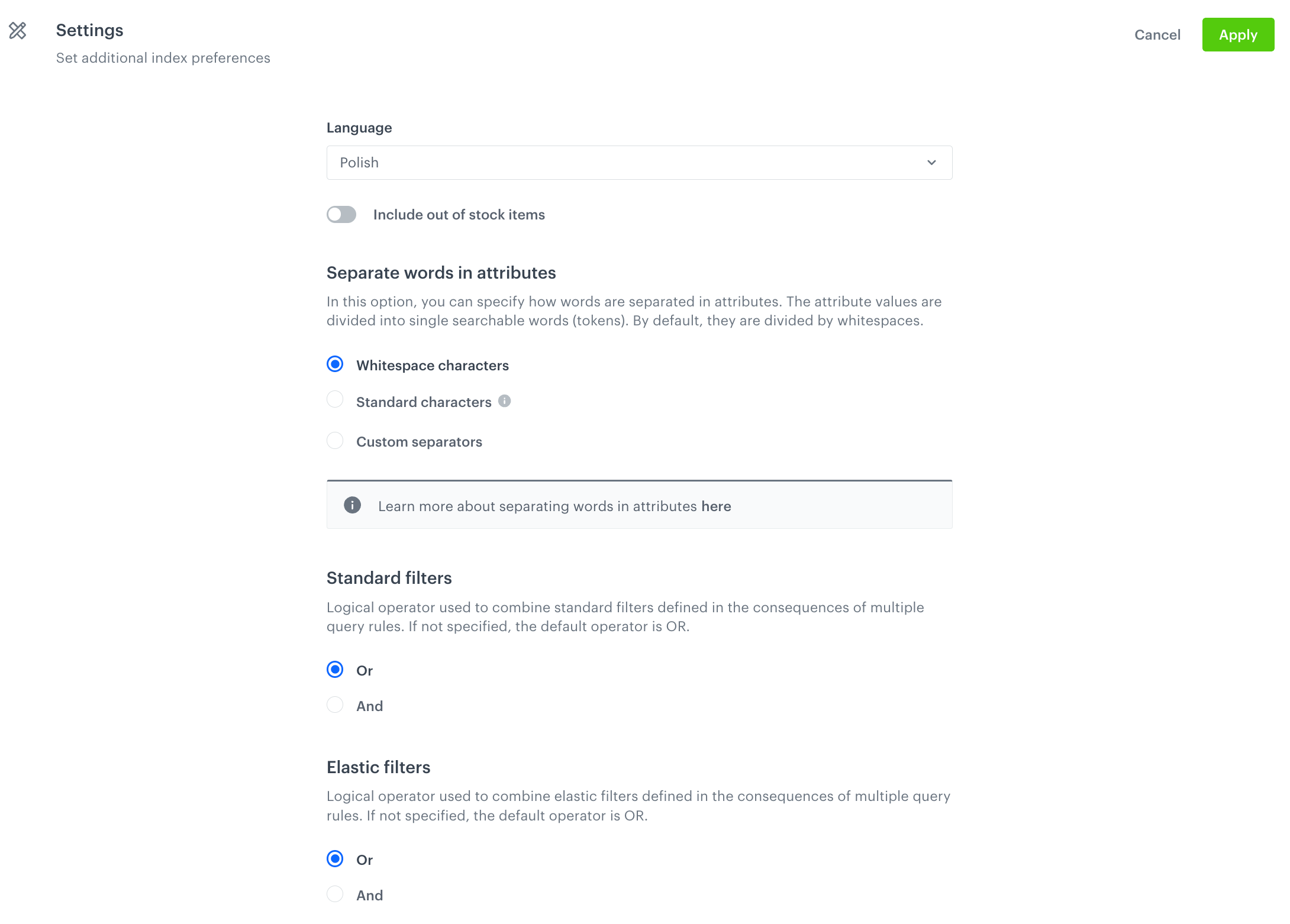
Configuration
- Go to AI Hub > Indexes.
- Create or select the index on the list.
- Go to the Settings tab.
- On the Settings section, click Define.
Selecting language
To select the language of the search engine, go to AI Hub > Indexes. Create an index or select an existing one from the list. Go to the Settings tab. In the Settings section, click Define.
- From the dropdown list, select a language.
- If you want to display unavailable items in the search results, enable the Include out of stock items option.
Defining separators
This option lets you define how words are separated in your attributes. The attribute values are divided into single searchable words (tokens).
- The default separator is a space.
- You can change to the Standard characters separator type. The full list of separators is available at UAX #29: Unicode Text Segmentation.
- You can also specify custom separators by adding them as Java Regular Expressions. All characters specified will be used as separators.
Example
If you want to divide attribute values into words (tokens) based on whitespace characters and the following three characters . , and /, enter the following pattern in the Custom separator input field:
[\s.,\/]+
Defining dependency among filters in multiple query rules
When two or more query rule conditions are met and their consequences include filters, you can choose the logical operator to combine those filters.
- For static filters, select either AND or OR in the Standard filters section.
- For elastic filters, select either AND or OR in the Elastic filters section.
This flexibility lets you to tune how multiple filters in many query rules interact, enabling more precise targeting and improved control over the resulting data.