Co-Brand Decisioning Layer segmentation based on average monthly transactions
In this use case, you will create a segmentation that groups customers based on their average number of transactions per month. This allows you to identify more and less active buyers and use that information in downstream actions, such as cross-workspace audience sharing, personalized recommendations, and dynamic content targeting.
Context
To make this scenario clear, we assume two separate workspaces:
- Workspace A – dedicated to Brand A
- Workspace B – dedicated to Brand B
Each workspace collects its own customer behavior data independently.
Goal
The main goal of this setup is to identify highly active customers (heavy buyers) in Workspace A (Brand A) and use this information in Workspace B (Brand B).
This allows you to deliver more relevant product recommendations and promotional communication to users who have already demonstrated strong purchasing intent in another brand ecosystem.
Process In Workspace A (Brand A):
- Calculate the average number of transactions per user per month.
- Based on this metric, create a segment of highly active customers (heavy buyers).
- Share this audience segment with Workspace B (Brand B). In Workspace B (Brand B):
- Target users from this imported segment when they visit Brand B.
- Use AI recommendations to present: products with a price higher than X, or products aligned with premium or high-value categories.
As a result users identified as heavy buyers in Brand A receive more tailored, potentially higher-value offers in Brand B.
Prerequisites
- Add a tracking code to your website.
- Create a workspace group connecting minimum 2 of your workspaces, giving you the possibility to synchronize profile information across them.
Process
- Create a segmentation of heavy buyers.
- Share the results from this segmentation to the workspace group.
- Create the final segmentation on the second workspace based on the membership attribute synchronization.
- Prepare the AI recommendations proposing products with the price higher than X and present them to users who are among heavy buyers on the first workspace while visiting the brand B.
- Create a dynamic content
Create a segmentation of heavy buyers
In this part of the process, you will create a segmentation of heavy buyers based on the number of transactions generated by these customers in the previous period. Before you proceed to creating the segmentation, you will create an aggregate and metric which you will use in the conditions of the segmentation.
Create an aggregate
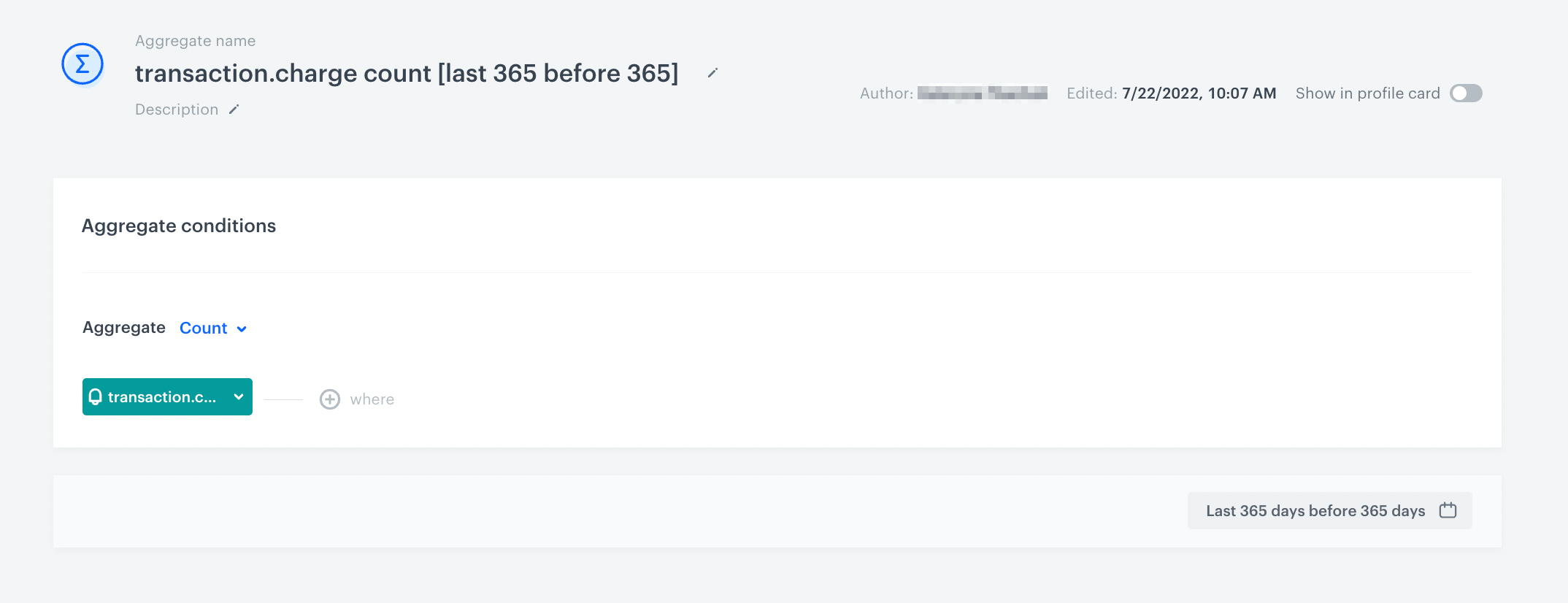
Create an aggregate that sums up the number of transactions in the previous period.
-
Go to
 Behavioral Data Hub > Aggregates > Create aggregate.
 -
As the aggregate type, select Profile.
-
Enter the name of the aggregate.
-
Click Analyze profiles by and select Count (this way the aggregate result will show the total number of transactions in the time range selected in the analysis).
-
From the Choose event dropdown list, select the transaction.charge event.
Tip:Events may have different labels between workspaces, but you can always find them by their action name (in this step, it’s **transaction.charge**). -
Change the date range, by clicking the calendar icon. Create the following custom date range
last 365 days before 365 days. -
Confirm the changes with the Apply button.
-
Save the aggregate by clicking Save.
Create a metric
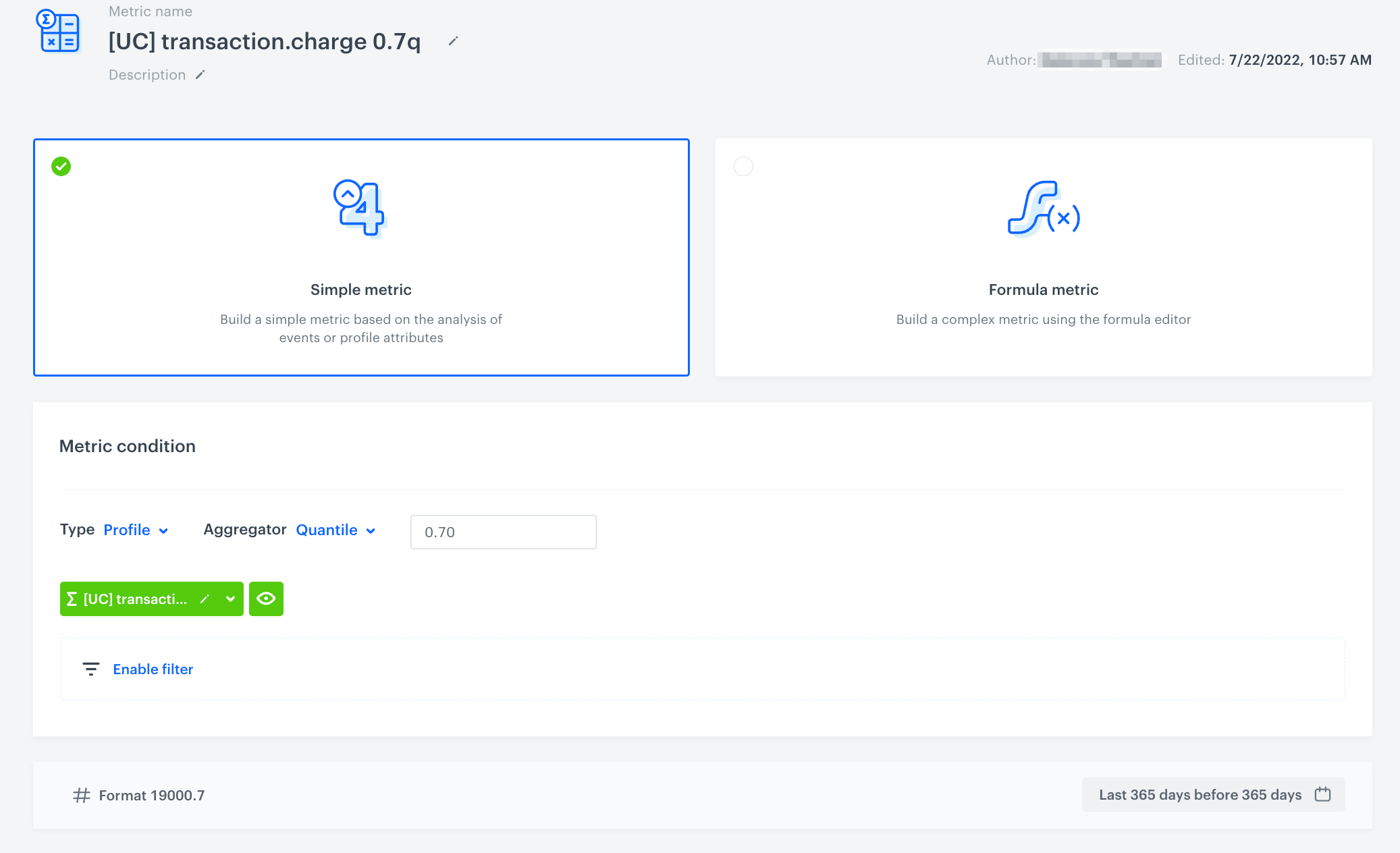
Create a metric that sets a cutoff value for the customer segmentation with the highest number of transactions.
-
Go to
Decision Hub > Metrics > New metric. -
Enter the name of the metric.
-
As a metric kind, select Simple metric.
-
As a metric type, select Profile.
-
As the aggregator, set Quantile.
Note: Quantile is used to divide a sample of data into equal-sized subgroups. -
In the input field which appears next to the aggregator, type
0.7(to create a cutoff that defines the highest number of values). -
Click Choose event.
-
From the dropdown list, select the aggregate you created before.
-
Define the same time range as in the aggregate you use in the metric.
-
Click Save.
Create a segmentation
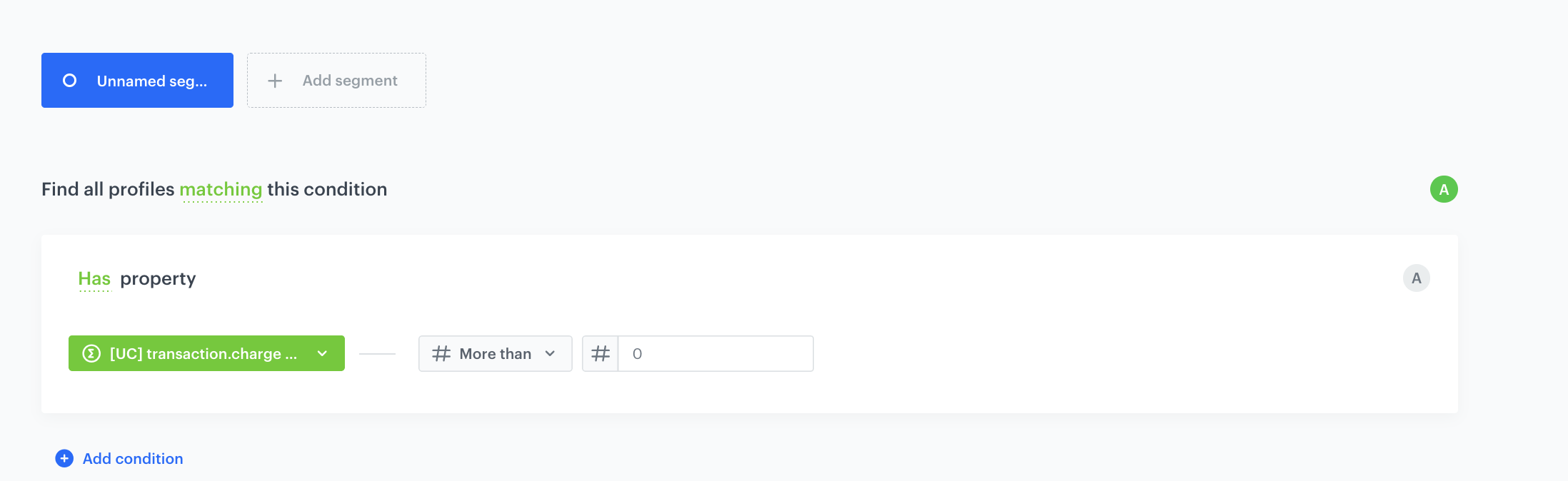
In this part of the process, you will create a segmentation of customers with the highest scoring (30% of customers who made the highest number of transactions).
- Go to Decision Hub > Segmentation > New segmentation.
- Enter the name of segmentation.
- On the canvas, click Add condition.
- From the dropdown list, select the aggregate you created before.
- From the Choose operator dropdown list, select More than.
- In the text field, enter the value returned from the metric you created in the previous step.
- Click Save.
Prepare the Multi Workspace Sync of Segmentation
-
Go to
Decision Hub > Segmentation. -
On the top bar on the segmentation list, click Share as.
-
On the pop-up, click Multi Workspace Sync.
-
From the Process frequency dropdown list, select how often membership attributes will be synchronized.
- Daily - The process will start once a day at a random time between 4 A.M. and 6 A.M.
- Every 6 hours - The process will start every 6 hours.
-
Click Go to sharing process.
-
On the pop-up, select the segmentations whose results will be shared and synchronized to a workspace group. The results will be saved as membership attributes.
Note:Only customers who belong to the selected segmentation and also exist in the target workspace will be assigned the membership attribute. During the sharing process, you will be informed about the default name of the membership attribute that will be created in the target workspace. Please note that this name cannot be modified at this stage. -
To start the process, click Apply.
-
Confirm by clicking Yes, start.
Result: The synchronization will occur according to the schedule. To get to know details about each synchronization time, time window and effects, see the “Synchronization ferquency” section.
Prepare the final segmentation
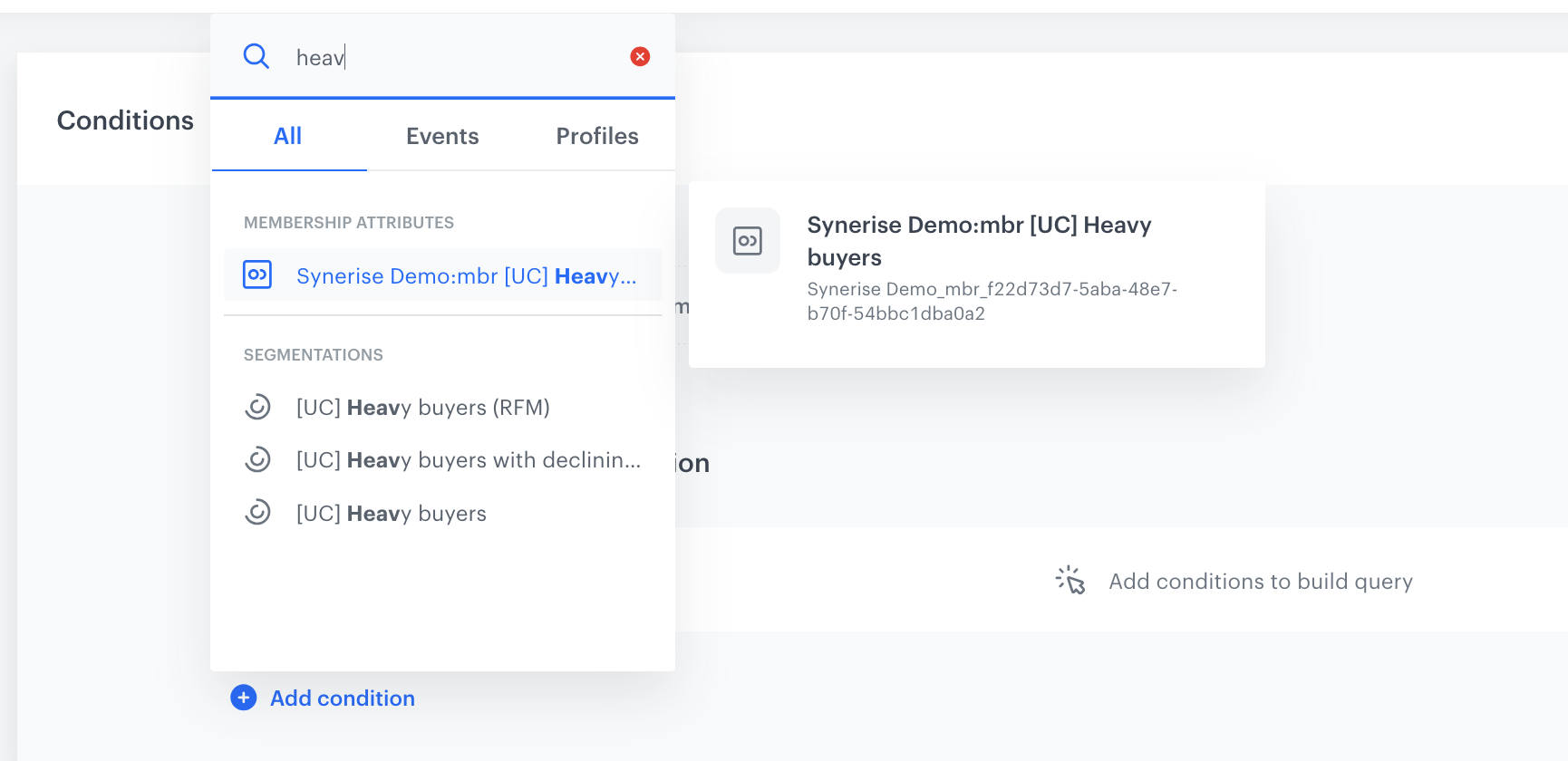
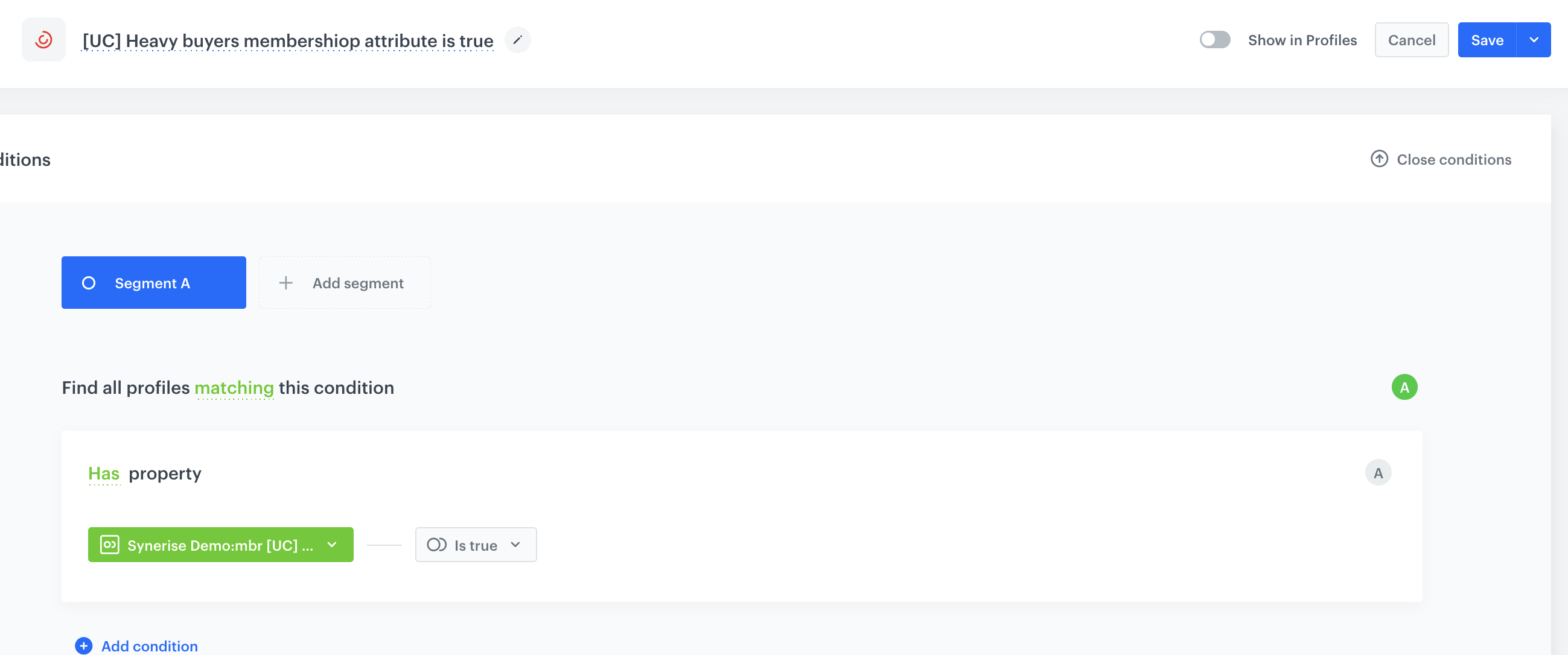
On the target workspace, create a segmentation based on the synchronized membership attribute.
-
Go to
Decision Hub > Segmentations > New segmentation. -
Enter the name of the segmentation.
-
Click Add condition.
-
Select the attribute created in the previous step. In our case it will look like this:
- From the Choose dropdown list, select is true operator.
- Click Save.
Prepare the AI recommendations
In this part of the process, you will configure AI Recommendation which excludes last seen and last bought products. AI Recommendation will be added to the product page.
-
Go to
 AI Hub > (AI Recommendations) Models > Add recommendation.
 -
Enter the name of the recommendation (it is only visible on the list of recommendations).
-
In the Type & Items Feed section, click Define.
-
From the Items Feed dropdown list, select an item feed.
-
In the Type section, choose the Personalized recommendation type.
-
Confirm the settings by clicking Apply.
-
In the Items section, click Define.
- Define the minimum and maximum number of items that will be recommended to the customer in each slot.
- Define Static filters and Elastic filters.
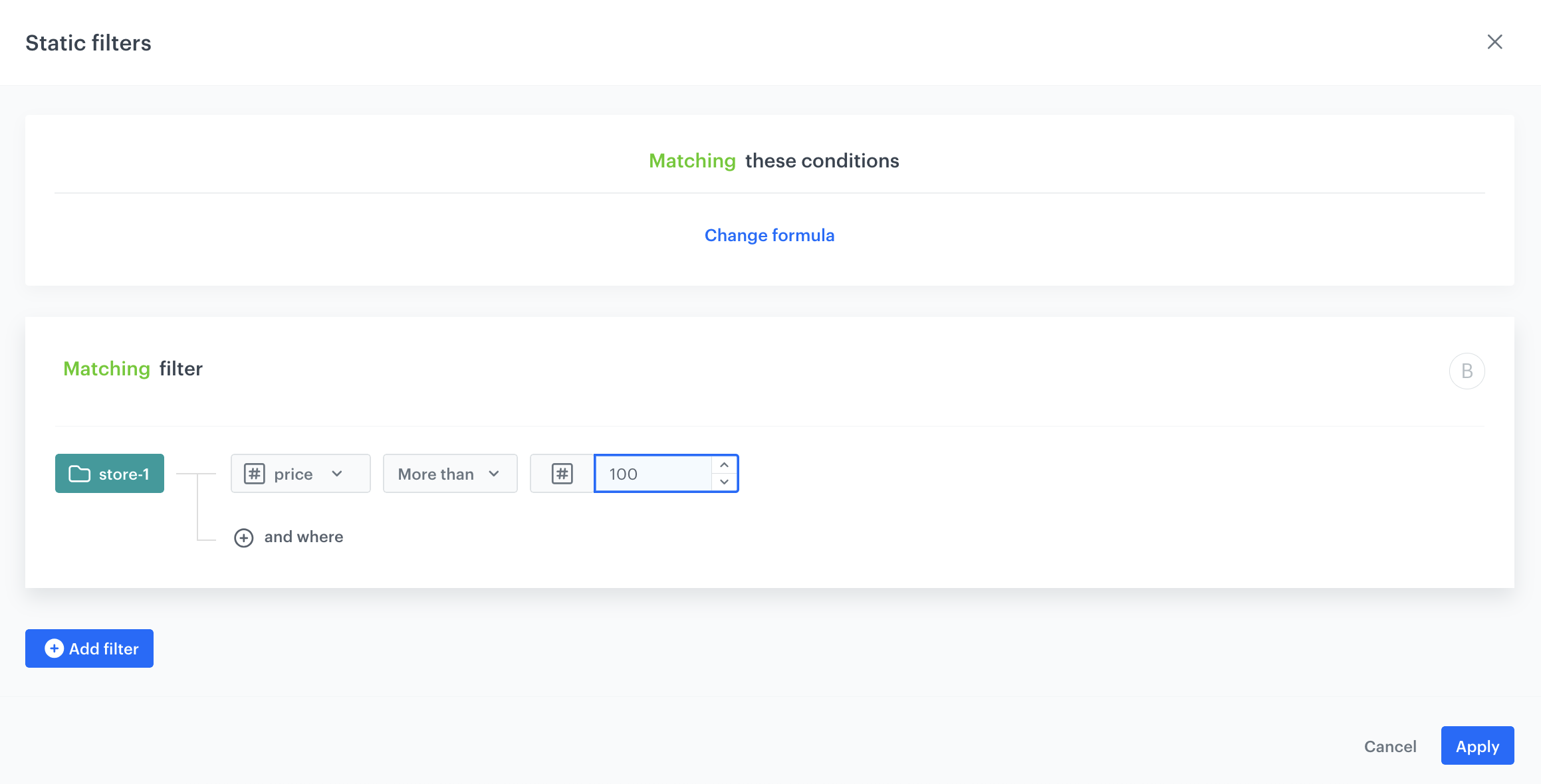
- In our case, in the Static filter section, click Define filter.
- Select Visual Builder.
- Click Select value.
- Choose $price.
- As an operator, choose More than.
- Add the value as
100. - Confirm by clicking Apply.
Configuration of the elastic filter -
Define the boosting rules by clicking Define in the Boosting section.
- In Attributes section, click Add rule.
- Click Define rule.
- Choose Visual builder.
- From the Select value dropdown list, choose price.
- As Operator, choose More than.
- As the value, enter the minimum price a product should cost to be included in the recommendations. This way, you exclude recommending products that are too cheap and encourage the purchase of more expensive ones.
- Click Apply.
- Click Promote.
- In the Impact section, set the impact of this rule to High.
-
Optionally add the Additional settings.
-
In the right upper corner, click Save.
Create a dynamic content
Create a dynamic content campaign that displays the results of AI recommendations (products more expensive than 100). Use the predefined template. This dynamic content will be displayed as a pop-up on your site for customers who are assigned with a membership attribute.
- Go to
 Experience Hub > Dynamic Content > Create new.
 - Enter the name of the content.
- Choose the Web layer type.
Define audience
- To select the recipients of the dynamic content, on the Audience tab, click Define.
- Select the target segmentation created based on the membership attribute synchronization in the previous step.
Define content
-
In the Content section, click Create Message.
-
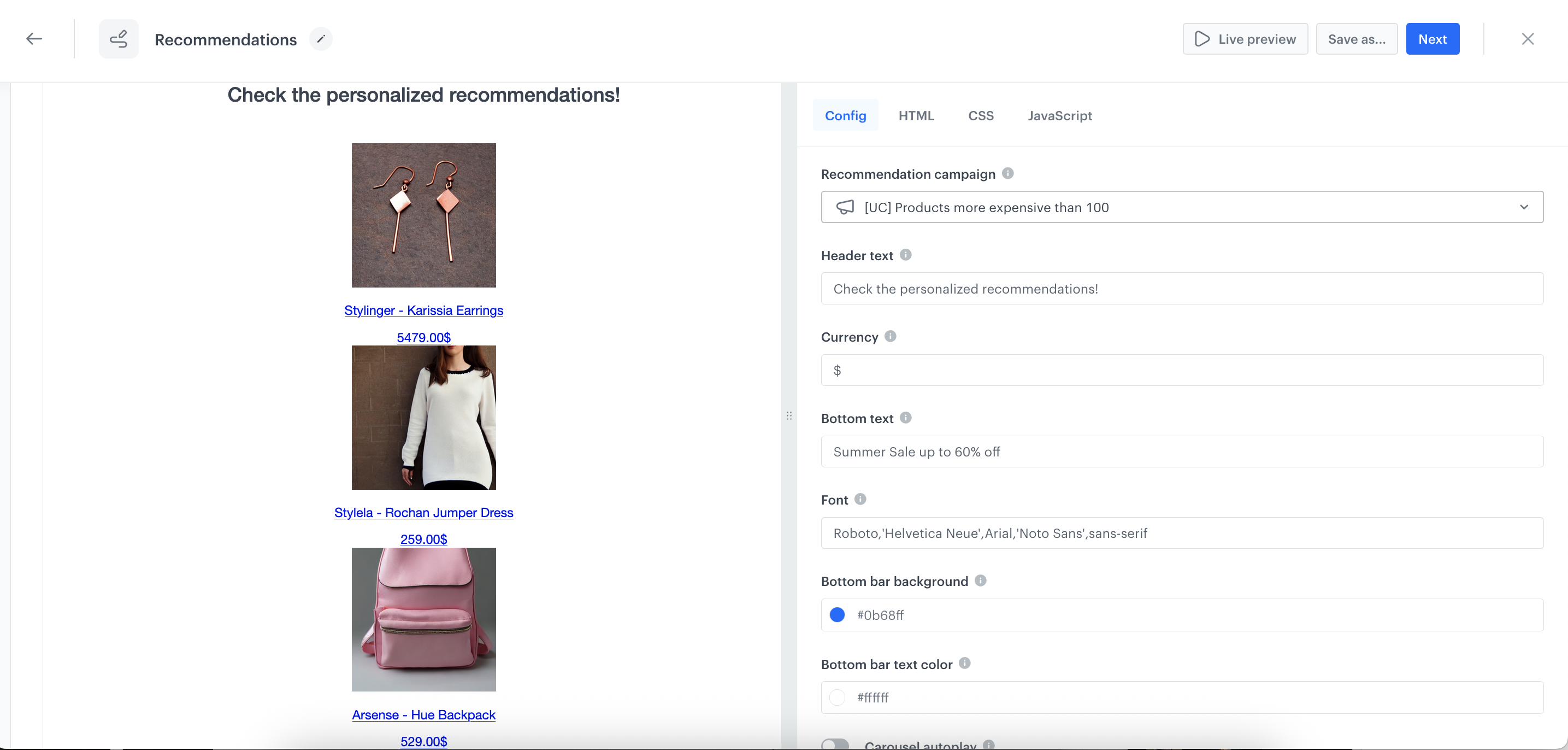
From the list of template folders, select a folder with the predefined Web layer templates or create your own one from scratch.
-
In the template configuration form, use the predefine AI recommendation selector and select the AI recommendation created in the previous step to make sure that you present only products more expensive than 100$.
Web layer template
Define schedule and display settings
- In the Schedule section, click Define and set the time when the message will be active.
- In the Display Settings section, click Define.
- Specify circumstances for dynamic content to be displayed. Optionally, you can also define Advanced options.
- Click Apply.
- Optionally, you can define the UTM parameters and additional parameters for your dynamic content campaign.
- Click Activate.
Check the use case set up on the Synerise Demo workspace
You can also check the configuration directly in Synerise Demo workspace:
If you’re our partner or client, you already have automatic access to the Synerise Demo workspace (1590), where you can explore all the configured elements of this use case and copy them to your workspace.
If you’re not a partner or client yet, we encourage you to fill out the contact form to schedule a meeting with our representatives. They’ll be happy to show you how our demo works and discuss how you can apply this use case in your business.

