In Files, you can upload files to Synerise and organize them in folders. You can use the uploaded files, for example, in messages you send to your customers, in dynamic content, or on landing pages.
The uploader accepts the following file extensions, with specific size limits assigned to each extension:
| Type | Extensions | File limit |
|---|---|---|
| Graphical | .jtif,.bmp,.tiff,.webp,.png,.gif,.jpg,.jpeg |
3MB |
| Multimedia | .gif,.mpg,.mpeg,.mp3,.webm,.mov,.mp4 |
10MB |
| Text/Data/Document | .xml,.pdf,.css,.csv,.json |
3MB |
| Other | .font,.ttf,.otf |
3MB |
Creating folders
- Go to
 Data Modeling Hub > Files.
- Optionally, open the folder in which you want to create the new folder.
- In the upper right corner, click New file or folder > New folder.
- In the Folder name field, enter a name for the folder.
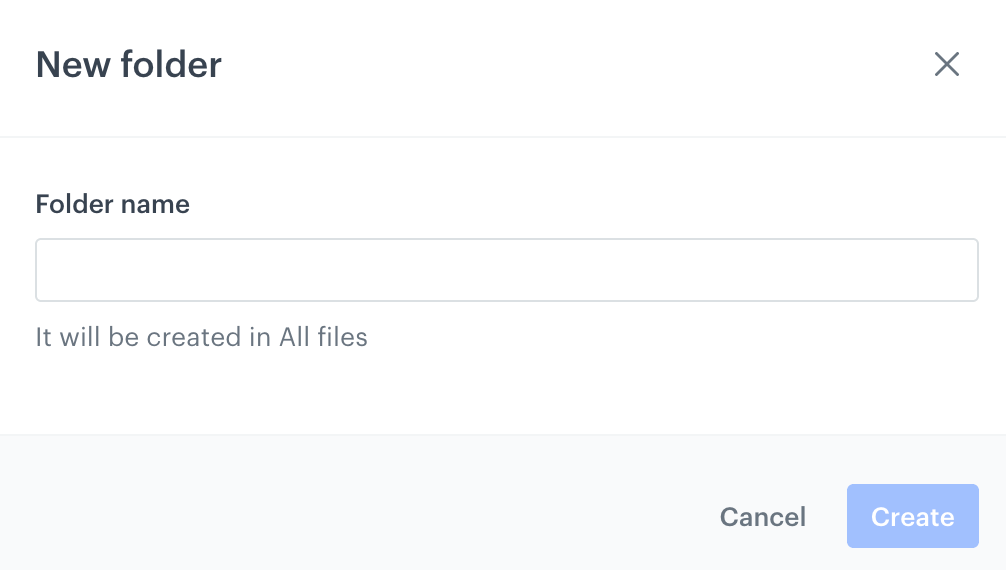
The New folder window - Click Create.
Result: The folder appears on the list and in the All folders section in the left pane.
Uploading files and folders
- Go to Data Modeling Hub > Files.
- Optionally, open the folder to which you want to upload the files.
- In the upper right corner, click New file or folder.
You can also drag files or a folder from your device and drop them on the list. Then go to step 6. - Select one of the options:
- Upload files to upload one or more files.
- Upload folder to upload all files from a folder on your device. The files are uploaded to a folder with the same name. If such a folder doesn't exist, it's created during the upload. Empty folders aren't uploaded.
- Select the files or the folder from your device.
Result: A window with the upload summary opens. - Optionally, to change the destination folder, click the folder name in the window title and select another folder.
By default, the files are uploaded to the folder you're currently in. - In the Summary section, check how many files will be uploaded.
The following files are skipped:- unsupported format: files with extensions that aren't listed in the table at the beginning of this article.
- already there: files with names identical to files which already exist in the destination folder.
- Optionally, in the Detail section, check the status of each folder or file.
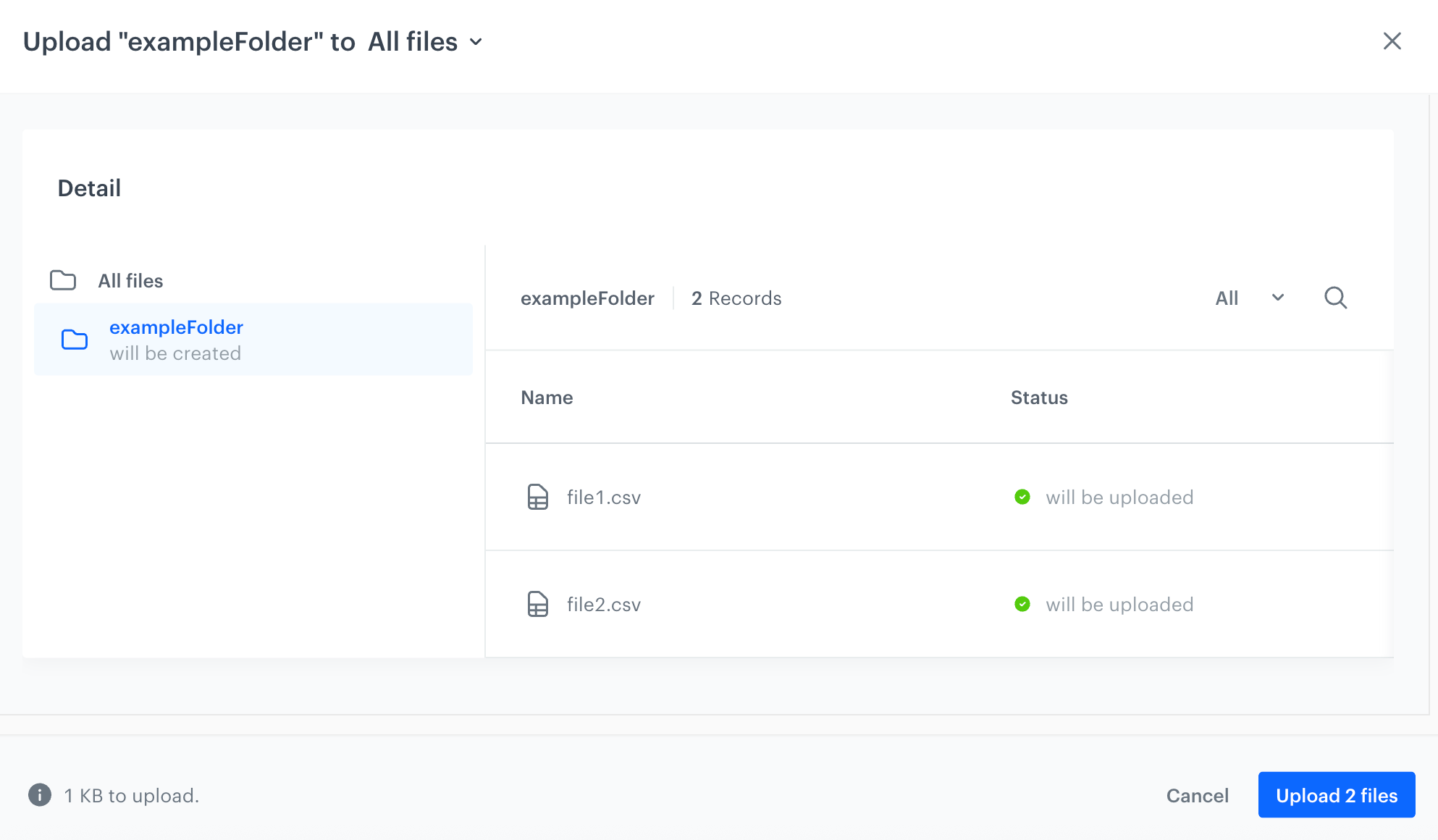
The Detail section of the upload window - Click Upload n files.
Result: The upload starts. You can track its progress next to the New file or folder button. To see the status of each file, click Details.
IMPORTANT: Stay in Files until the upload is finished. If you go to another module or close the browser tab, the upload stops.
Managing files and folders
- Go to Data Modeling Hub > Files.
- On the list, find the file or folder.
- In its row, click
 .
- From the dropdown list, select one of the options:
- Preview (files only): open a preview of the file.
- Rename: change the name of the file or folder.
- Star (files only): add the file to the Starred list.
- Duplicate: create a copy of the file or folder.
- Move to: move the file or folder to another folder.
- Show audit log: see the history of changes.
- Delete: remove the file or folder.
- Copy URL (files only): copy the URL of the file to the clipboard. You can use the URL to link to or embed the file in messages, dynamic content, or landing pages.
- Copy ID (folders only): copy the ID of the folder to the clipboard.
Renaming or moving files and folders doesn't change the URLs of the files, so the links you use, for example, in campaigns or on landing pages keep working.
Retrieving HTML img tag
IMPORTANT: Available only for graphical file formats.
Using the HTML "img" tag lets you display the image on a web page.
- Go to Data Modeling Hub > Files.
- On the list, find the image.
- Click the image on the list.
Result: Image details appear on the right side of the screen. - From the HTML Code field, copy the HTML snippet.
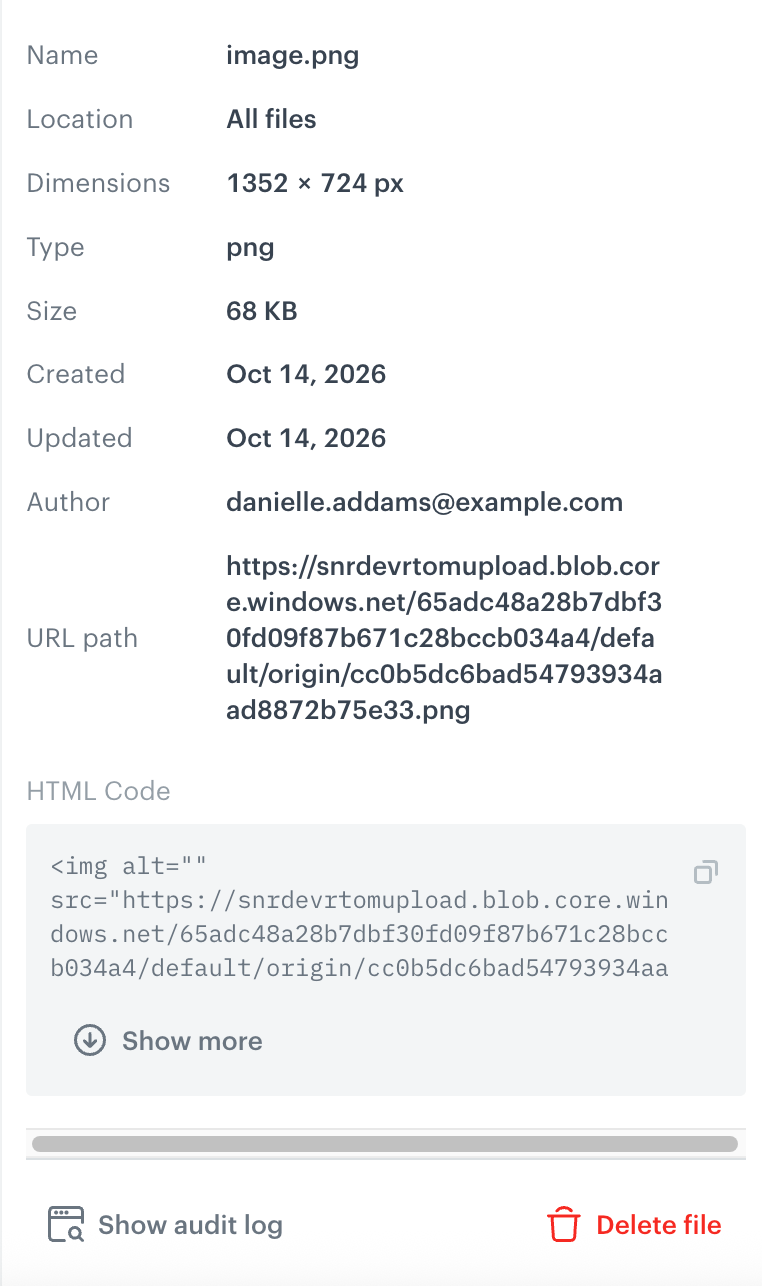
The HTML Code field in the image details
Deleting files
If you want to get rid of the files you no longer need and thus facilitate navigating through the list of the files, perform the steps described in the instruction below.
- Go to Data Modeling Hub > Files.
- On the list, find the file which you want to delete.
- In the row of the file, click .
- From the dropdown list, click Delete.
Result: The file is removed from Files.
Deleting folders
You can delete a folder only if it contains fewer than 50 items.
- Go to Data Modeling Hub > Files.
- On the list, find the folder which you want to delete.
- In the row of the folder, click .
- From the dropdown list, click Delete.
- If the folder isn't empty, select what to do with its contents:
- Move contents to All files: the folder is deleted and its files are moved to All files. The URLs of the files don't change.
- Delete contents: the files are permanently deleted together with the folder. You can't undo this action.
- Click Yes, delete.
Result: The folder is removed from Files.