Weather APIs return more data than a content template needs. A Brickworks response transformer combines the temperature and its unit into one field that a content consumer can use.
In this use case, you will connect Open-Meteo as an external source, create a Singleton schema with an External Data field, and transform the response into a temperature value such as 23.6°C
Prerequisites
- Access to Data Modeling Hub, with permission to create the required connection, external source, schema, and response transformer.
- A weather API endpoint that returns the current temperature and its unit. This example uses Open-Meteo.
- Latitude and longitude values to pass when generating the record. This example uses
lat: 50andlng: 20
Process
In this use case, you will go through the following steps:
- Create an external source that retrieves weather data.
- Create a schema with an External Data field that uses this source.
- Create a response transformer that combines the temperature and unit.
- Preview the transformed response result before activating the transformer.
Create an external source
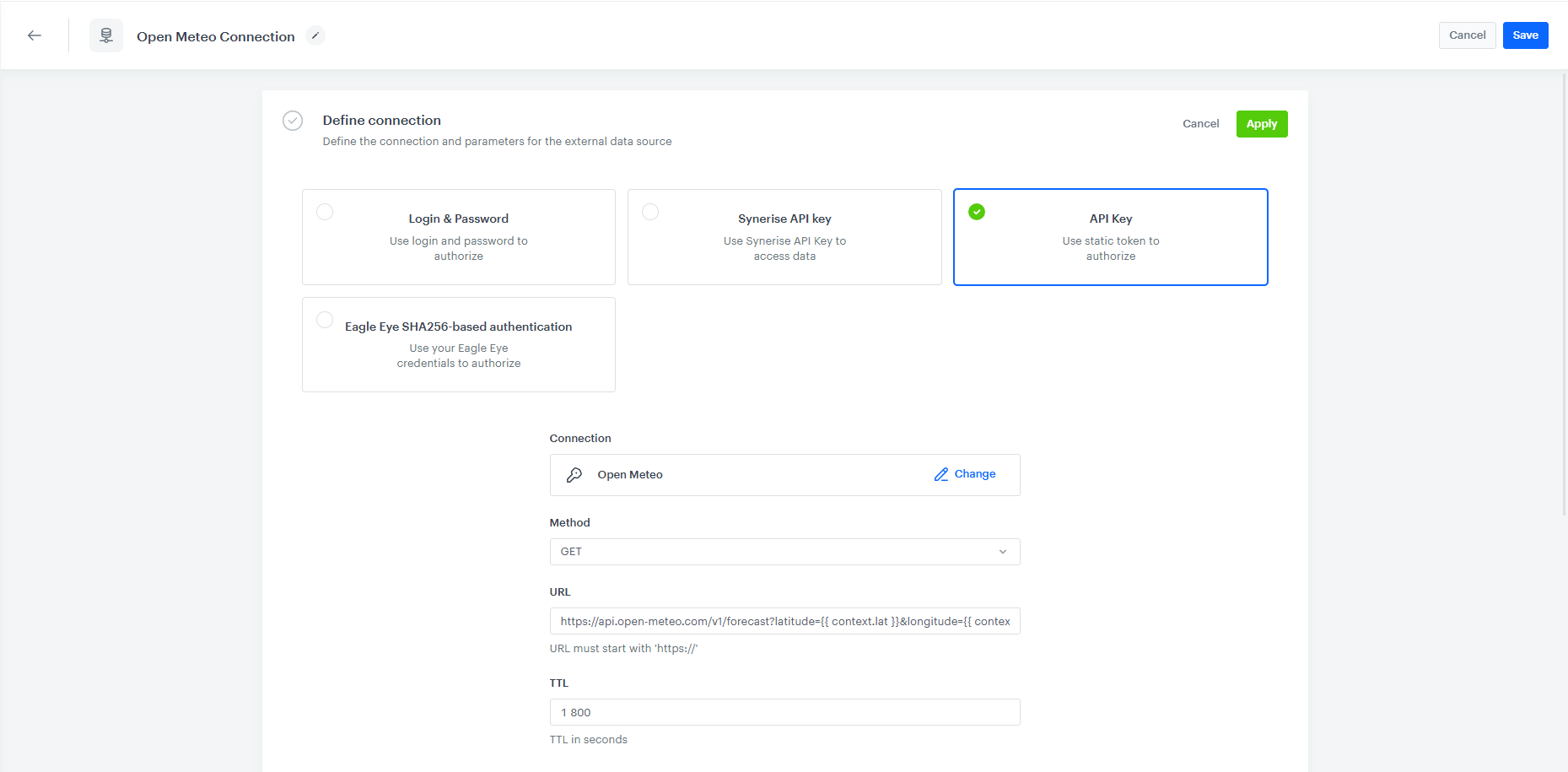
In this part of the process, you will define where Brickworks fetches weather data from. The external source defines the request to the weather provider. It can be reused by the error-handling example described in the follow-up use case.
- Go to Data Modeling Hub > External sources > New external source.
- Name the source
Open Meteo Connection - Select or create the connection required by the external source.
- From the Method dropdown list, select the GET request method.
- In URL, provide the Open-Meteo forecast endpoint with the coordinates passed from the generation context:
https://api.open-meteo.com/v1/forecast?current=temperature_2m,[OTHER_CURRENT_PARAMETERS]&latitude={{ context.lat }}&longitude={{ context.lng }} - Replace [OTHER_CURRENT_PARAMETERS] with the list of current parameters you need. The response shown in this use case was generated with a query that requested
temperature_2m,relative_humidity_2m,apparent_temperature,is_day,precipitation,rain,weather_code,cloud_cover,wind_speed_10m,wind_direction_10m, andwind_gusts_10m. The full query string is [to be completed / TBC]. Configure the request method, endpoint, and parameters for your weather API. Pass the latitude and longitude from the generation context to the request. - In TTL, set the response cache TTL to match your data freshness requirements. Cached responses can be reused until the TTL expires. A shorter TTL returns more current weather, a longer TTL reduces the number of calls to the API. The maximum is 1800 seconds.
- Save the external source.
Create a schema with an External Data field
Create a singleton schema that makes the external response available to the transformer.
- Go to Data Modeling Hub > Schemas > New schema.
- Set Display name to
Current Temperature - Set the schema type to Singleton.
- Add an External Data field with the display name
Open Meteo Connection - Set the field's API name to
openMeteoConnection, which the transformer below references. - Select the external source created in the previous step.
- Save the schema. This example includes the following values inside the external response. This is an excerpt, not the full generated object:
Create a response transformer
When you make a request to generate an object from the schema, the external resource returns more data than necessary to show the temperature. The temperature is also split into two objects - one for the number and one for the unit:
{
  "current": {
    "temperature_2m": 23.6
  },
  "current_units": {
    "temperature_2m": "°C"
  }
}
The transformer accesses this response through generated.openMeteoConnection
To remove the unnecessary data and turn the temperature into a single string that is returned as the field value, create a data transformer:
- In the schema editor, open Response transformers.
- Select Edit > Add transformer.
- Enter
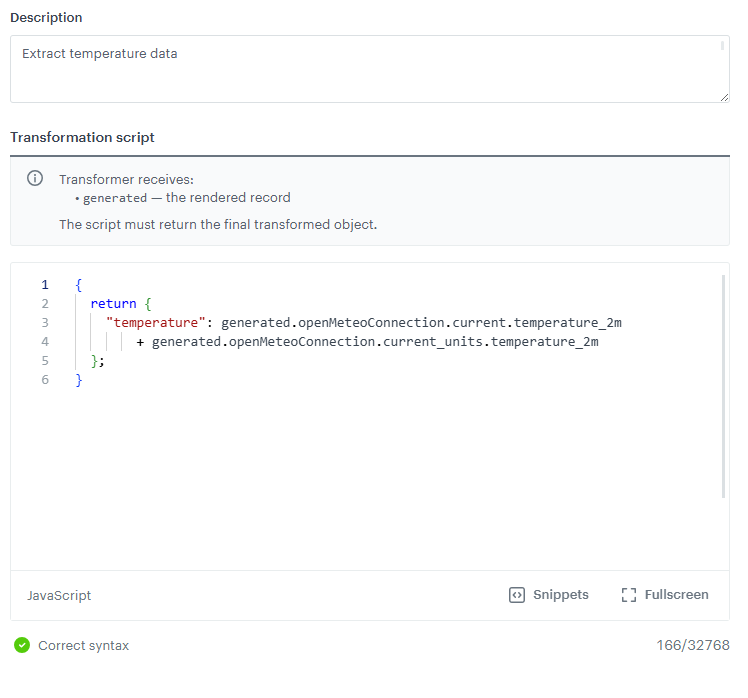
Extract temperature dataas the name. - Add a description, such as
Combines the temperature value and unit into one field - Enter the transformation script.
{ return { temperature: weather.current.temperature_2m + weather.current_units.temperature_2m }; } - Click Save or Save and close.
IMPORTANT: This script returns a new object that contains only the temperature field. It does not preserve other generated fields.
Preview the transformed response
Test the transformer before selecting it as the active transformer for the schema.
- Open the record preview for this schema.
- Set the coordinates for the example: latitude
50, longitude20 - On the Transforming response tab, select
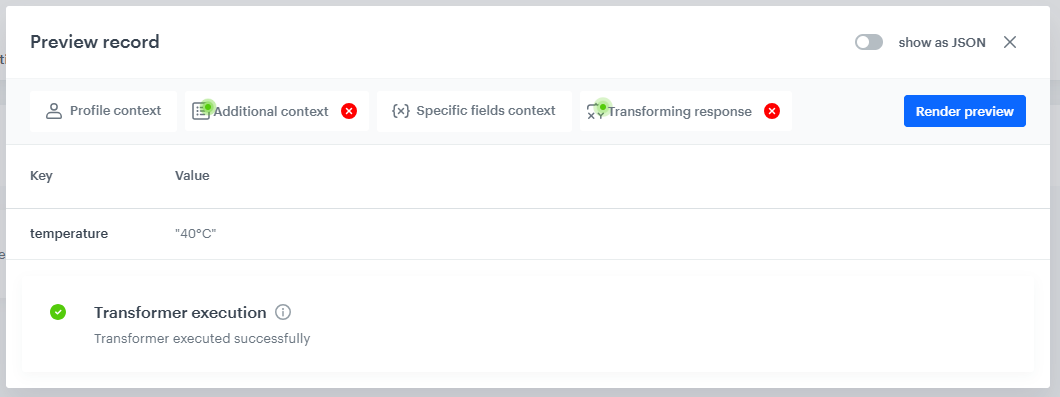
Extract temperature data - Generate the preview and inspect the response. For the sample weather response shown earlier, the transformed result is:
{
    "temperature": "23.6°C"
  }
Record preview with the temperature - After checking the preview, select the transformer as the active one on the schema's Response transformers tab.
- Click Apply.
- Save the schema when ready to use this output.
Limitations
- The transformer runs on the top-level record requested for generation. Transformers on nested records are not processed automatically.
- Only one transformer can be active for a schema, although other transformers can be selected in preview.
- This example expects a successful weather response. It does not handle a missing response or an error returned by the provider.
What's next
Extend the example to handle weather API error responses. The companion article uses the same external source and returns different results for valid and invalid coordinates.