In the Synerise template builder, you can create your SMS. The editor includes real-time SMS validation that detects character encoding (GSM-7 or UCS-2), calculates the estimated number of SMS messages sent per recipient, and highlights problematic characters in the preview. If the message contains invisible or non-GSM-7 characters, you can use the Clean SMS tool to fix them before saving. After you create the template, you can proceed to sending the text message.
Alternatively, you can create a template on the go while creating the SMS communication.
Create a template
- Go to Experience Hub > SMS.
- In the menu on the left, click Templates.
- Click Create new. The text editor and SMS preview open.
In the text box on the right, enter the contents of your message. You can:
- use emoji,
- shorten the links,
- use inserts to personalize content and add tracking of UTM parameters and click events for redirect URLs,
- remove invisible and non-GSM-7 characters using Clean SMS.
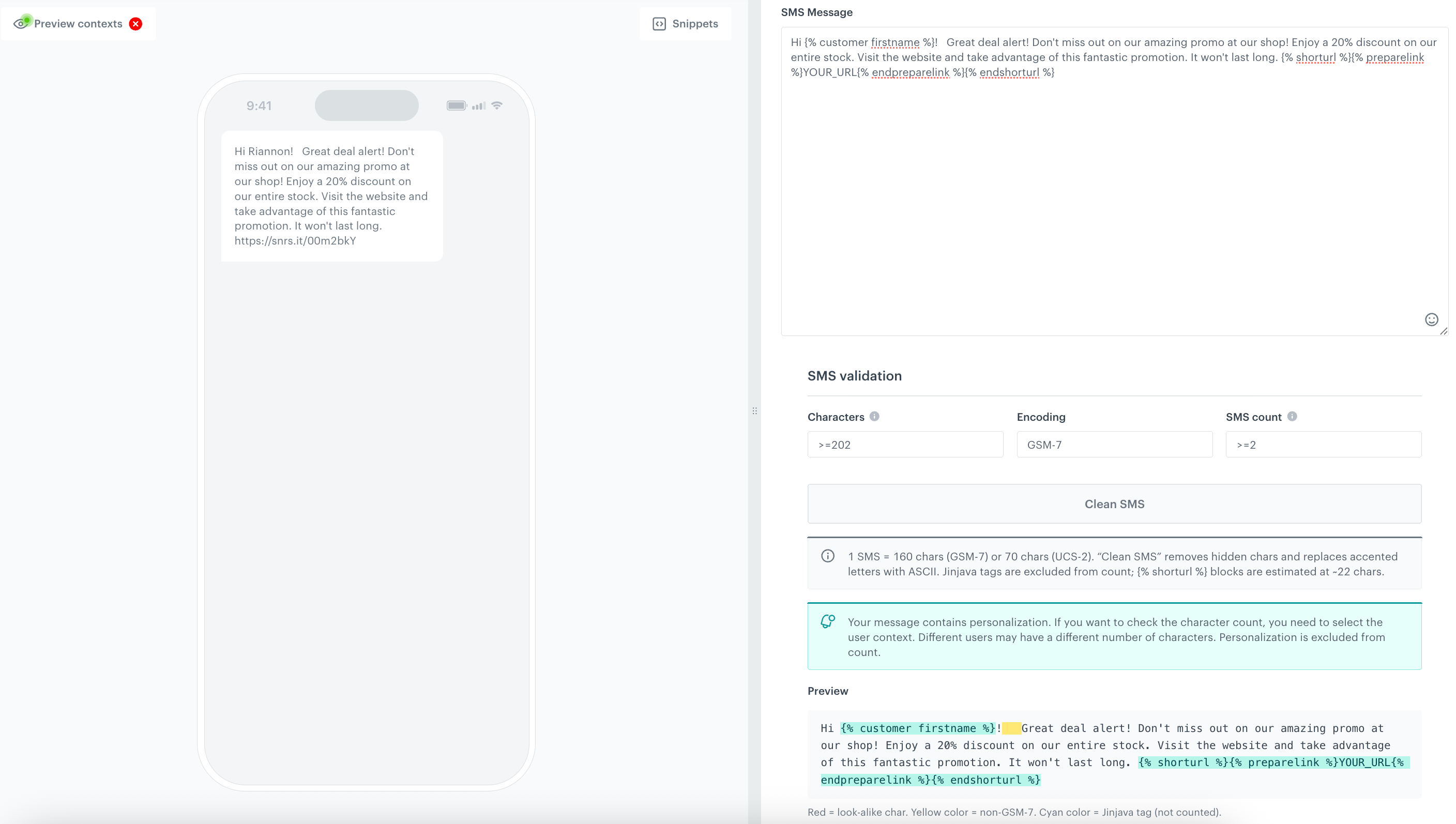
Example of an SMS template
Tracking parameters in links
To include tracking parameters and UTM and link parameters in the links in a template, always wrap the link with the {% preparelink %}{% endpreparelink %} insert.
Short links
If you send links in text messages, you can use a Jinjava code to shorten the URL addresses to make the text message look professional and the link more reliable.
- The default domain of the shortened links is
snrs.it. If you want to use your own domain, see Custom subdomain for shortened links. - The shortened links don't require HTTPS. If you include a link with
http://in the message, it will be redirected to HTTPS when opened. - You can combine short link insert with prepare link to track URL's parameters (such as UTM) and click events from a message.
WARNING: The shortened link is valid for 14 days from the date the message is sent.
IMPORTANT: Percent-encode any special characters in the URL before you shorten it — for example, encode a space as %20. For the encoding rules, see RFC 3986: Uniform Resource Identifier (URI): Generic Syntax.
| Jinjava code | Description |
|---|---|
|
The URL is shortened, however, the clicks aren't collected. |
|
The URL is shortened and the clicks in the link are collected, so this event can be used in analyses. |
Example
{% shorturl %}{% preparelink %}https://example.com/season-discounts/?utm_source=examplecom&utm_medium=slider&utm_content=examplecom&utm_term=discount-amazon-perf-2_W3&utm_campaign=Campaign-OnGoing{% endpreparelink %}{% endshorturl %}Result
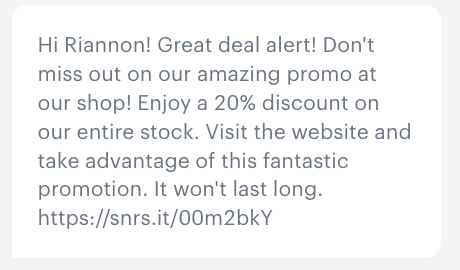
Personalization
You can also personalize the message by inserting dynamic elements, for example:
- an attribute such as the name or any other piece of information you collected about a profile (city, age, and so on),
- the number of collected loyalty points,
- a discount coupon.
In Insert usage, you can find a list of inserts and examples of their usage.
SMS validation
The editor includes a real-time SMS validation panel below the message field. The panel shows three values:
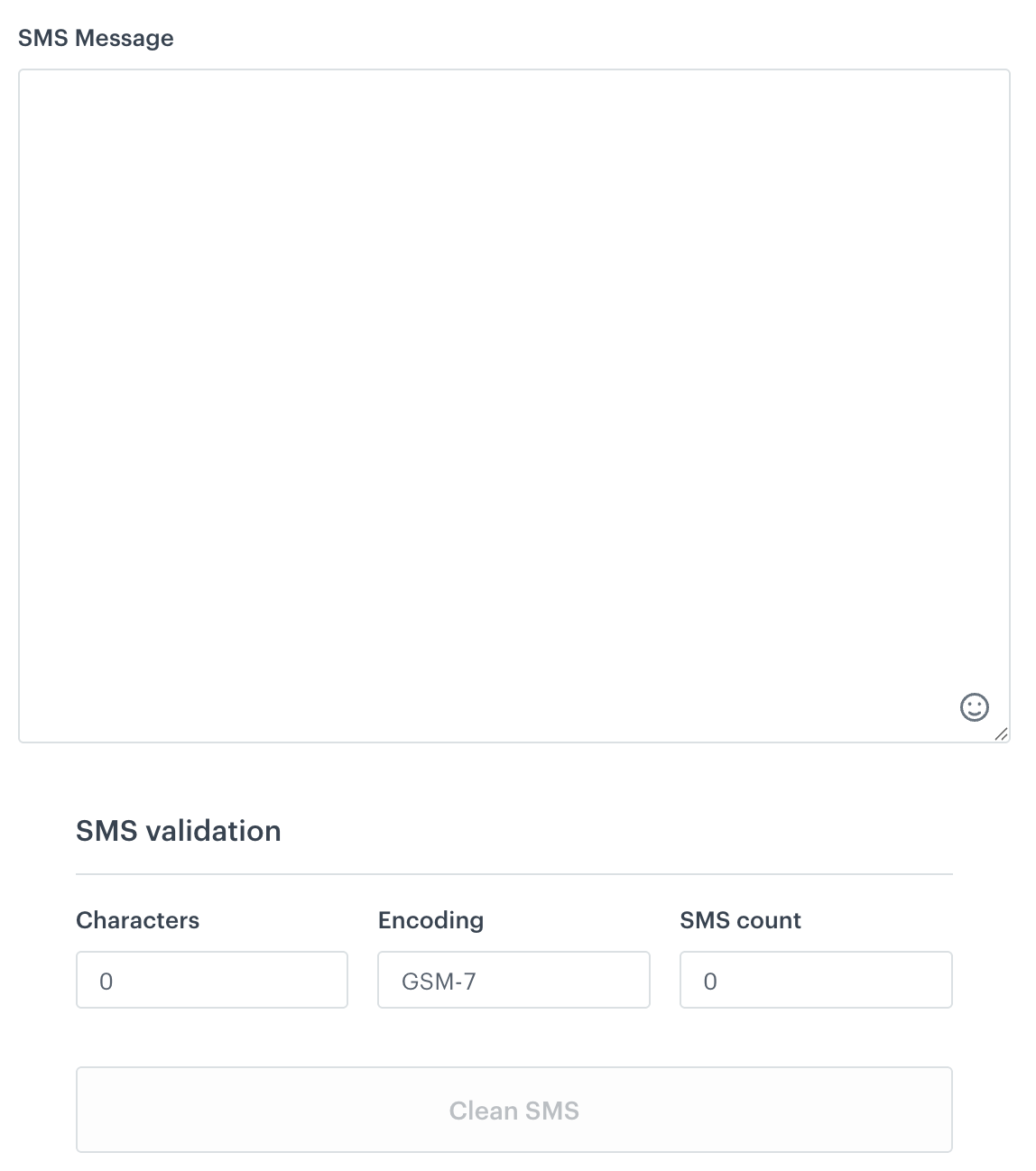
- Characters - the number of characters in the current message.
- Encoding - the encoding the message will use: GSM-7 or UCS-2.
- SMS count - the estimated number of SMS messages sent per recipient. Use this to anticipate the cost of your campaign before sending.
The segment limits depend on encoding:
- GSM-7 - 160 characters per segment.
- UCS-2 - 70 characters per segment.
Copying text from Word or Google Docs can introduce invisible Unicode characters — for example, zero-width spaces (ZWSP), non-breaking spaces, or smart quotes. These characters silently switch encoding from GSM-7 to UCS-2, which cuts the per-segment limit from 160 to 70 characters and can more than double the number of SMS segments sent, increasing cost without a visible change to the message text.
Preview color coding
The Preview section below the validation panel highlights problematic characters using color:
- Red - look-alike or invisible characters (for example, ZWSP).
- Yellow - non-GSM-7 characters.
- Cyan - Jinjava tags (excluded from the character count).
Personalization and character count
Jinjava personalization tags (for example, {{customer.firstname}}) are excluded from the character count because their rendered length varies per recipient. When your message contains personalization, the Characters and SMS count fields show a minimum estimate (for example, >=100 and >=1). To check the character count for a specific recipient, click Preview contexts in the upper left corner and select a user profile.
Clean SMS
If the message contains hidden or non-GSM-7 characters, the Clean SMS button becomes active. Click it to open the Clean SMS modal, which shows a before-and-after comparison:
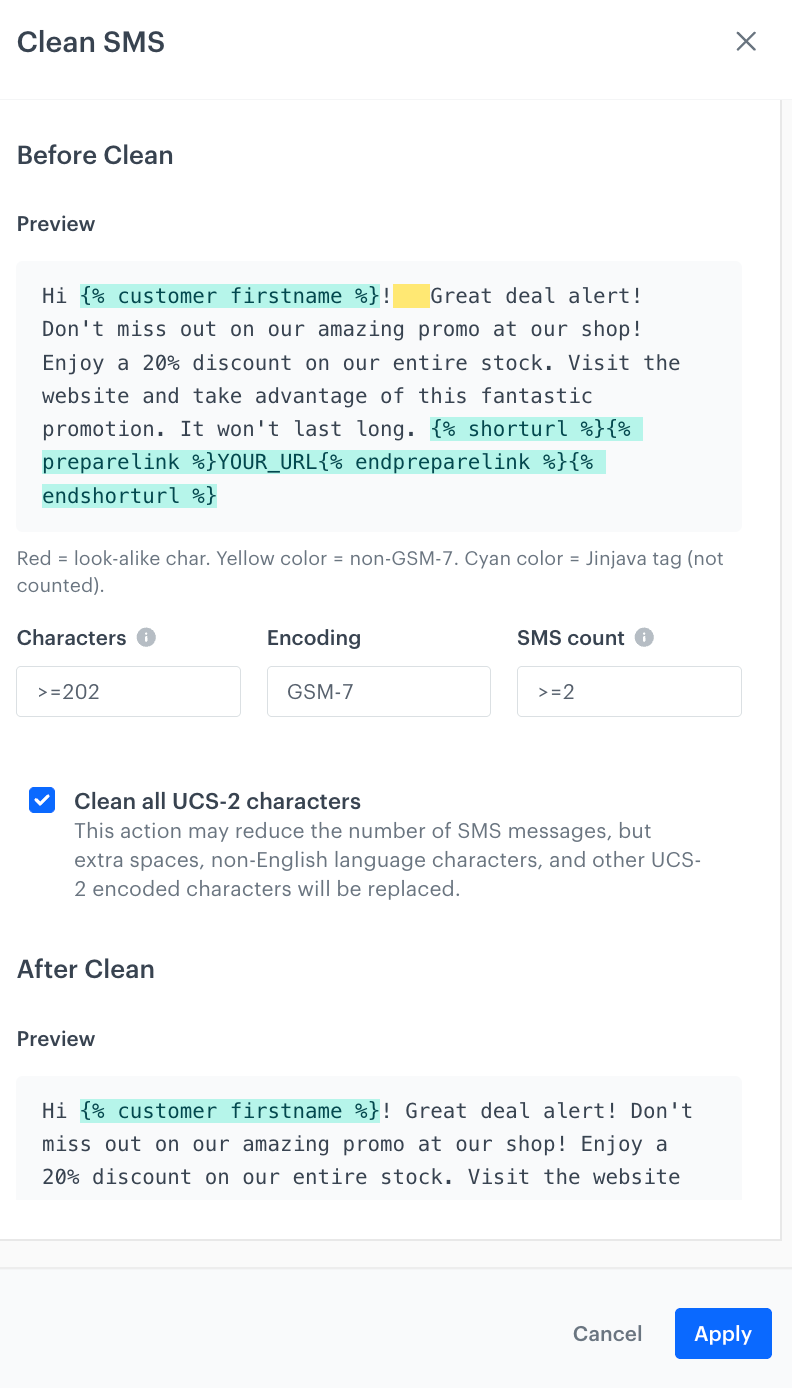
- Before Clean - the current message with character count, encoding, and SMS count.
- After Clean - a preview of the cleaned message with updated stats.
- To replace non-GSM-7 characters, hidden characters, and accented letters with their ASCII equivalents, select Clean all UCS-2 characters. This can reduce the SMS count, but it also removes non-English characters that are intentional.
- To replace the message content with the cleaned version, click Apply.
When the message contains no problematic characters, the panel displays: Content is clean — fits in GSM-7, no hidden characters.
Preview the template
- To check the preview of the template for a particular customer, click the Preview context button on the upper left side.
- Enter the ID of a customer.
- Click Apply.
Result: You see the preview of the template for the particular customer. If you use a custom domain for short links, the preview shows the default domain, but the custom domain will be used in the actual campaign.
Save the template
If Service approval is not configured:
- To go directly to launching an SMS campaign, click Use in communication and follow the instructions here.
- To save the template:
- Enter the name of the template.
- Select the folder where the template will be saved.
- Click Save this template.
Result: A dropdown appears. - Click Save as.
Result: The template is saved in the selected folder.
If Service approval is enabled for Experience Hub, to complete the work over the template:
- If you are a regular user, to send the template to reviewers and a final approver, click Send to approval.
- If you are a reviewer, to approve a template, click Approve.
Result: If the template is approved, it will either be automatically sent to the final approver or await approval from another reviewer. If the template is disapproved, it will be marked as Rejected and the review process will start over. - If you are a final approver, to let yourself approve the template, click Approve.
Result: The template can be used in an SMS campaign.